
New research by Dr. Steve Grasby, Research Scientist at Natural Resource Canada's Geological Survey of Canada, could indicate a more habitable environment than previously thought for the red planet, Mars.
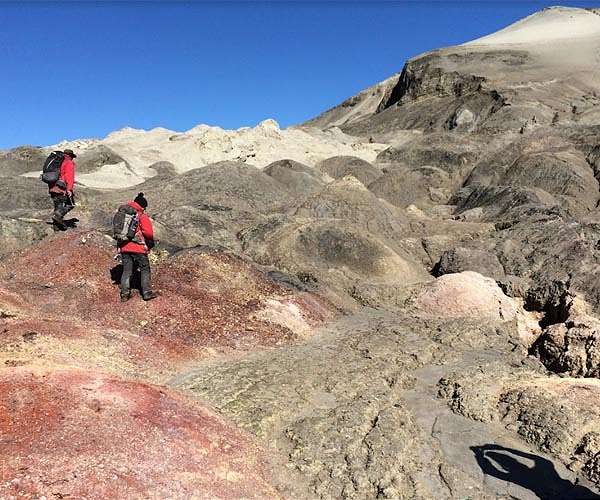
Located on the northernmost point of mainland Northwest Territories, Canada, the Smoking Hills (Inuvialuit name "Ingniryuat") are a unique geological formation. Named after the smoke created by auto-combusting mudstones (shales that burn naturally), the Smoking Hills produce hot sulphuric acid gas released from vent holes surrounded by brightly coloured mineral deposits.
"We needed to be careful that our boots didn't melt while we were working," said Dr. Grasby.
While the mudstones from Smoking Hills form some of the most acidic and toxic natural waters on Earth, new research suggests this environment can tell us more about Mars.
In his paper, Dr. Grasby closely examines the mudstones of the Smoking Hills. Samples from this unique environment showed jarosite-rich layers, similar to those observed in mudstones on Mars.
Jarosite is a mineral that forms in very acidic environments; therefore, its discovery as layers in rocks on Mars has been previously used to suggest that the planet was covered in acid ponds and lakes early in its history.
"The jarosite here on earth were formed in normal marine conditions, thriving with life," explains Dr. Grasby. "These findings could imply that the jarosite found on Mars did not necessarily reflect harsh acidic conditions, allowing for near-neutral pH waters on Mars more amenable to supporting life."
To better compare these rare minerals, scientists will need to examine jarosite samples from the Smoking Hills using equipment and methods similar to those used by Mars orbiters and robots.
