
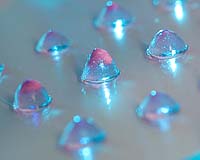
U.S. medical scientists say they have developed a self-assembling hydrogel delivery system that's biocompatible, efficient and easy to tailor.
The researchers from the Harvard-Massachusetts Institute of Technology Division of Health Science and Technology say the hydrogel can deliver clinically approved drugs in high concentrations without requiring carriers for the drug or generating toxic components, which previously have been a problem in hydrogel systems.
"This strategy could serve as the platform technology for developing drug-based delivery carriers that can release drugs such as anti-inflammatory agents on demand in response to inflammation, for example," said Dr. Jeffrey Karp, a co-corresponding author in the study.
"Converting known, clinically practicing drugs into amphiphilic molecules which can undergo self-assembly is the key development in our present research; this may eliminate the need for an external carrier for delivering drugs," added Praveen Kumar Vemula, a research fellow in medicine at Brigham and Women's Hospital.
The study that included Dr. George John, an associate professor at the City College of New York, and Gregory Cruikshank is available online at Science Direct and is to appear in the Nov. 25 print issue of the journal Biomaterials.
