
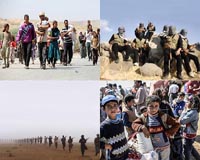
A new study, published in the journal Political Geography, shows that there is no sound evidence that global climate change was a factor in causing the Syrian civil war.
Claims that a major drought caused by anthropogenic climate change was a key factor in starting the Syrian civil war have gained considerable traction since 2015 and have become an accepted narrative in the press, most recently repeated by former US vice president Al Gore in relation to Brexit. This study, led by Professor Jan Selby at the University of Sussex, takes a fresh look at the existing evidence for these claims as well as conducting new research into Syrian rainfall data and the experiences of Syrian refugees.
Professor Jan Selby, Director of the Sussex Centre for Conflict and Security Research at the University of Sussex, says: "Our paper finds that there is no sound evidence that global climate change was a factor in sparking the Syrian civil war. Indeed, it is extraordinary that this claim has become so widely accepted when the scientific evidence for it is so thin.
"Global climate change is a very real challenge, and will undoubtedly have significant conflict and security consequences, but there is no good evidence that this is what was going on in this case. It is vital that experts, commentators and policymakers resist the temptation to make exaggerated claims about the conflict implications of climate change. Overblown claims not based on rigorous science only risk fueling climate scepticism."
Professor Selby worked on the study with Christiane Frohlich from the University of Hamburg's Center for Earth System Research and Sustainability (CEN), Omar Dahi from Hampshire College, and Mike Hulme from King's College London.
Their article is published in a special section of the journal Political Geography, the leading outlet worldwide for the study of climate-conflict linkages. The article is accompanied by three responses from leading US-based academics, and a rejoinder from Selby and colleagues. All are available open access for a limited period.
Selby and colleagues' article finds that:
1.Although northeast Syria did experience an exceptionally severe drought prior to its civil war, this drought was not necessarily caused by human influences on the global climate;
2.Though the 2006/07 to 2008/09 drought did contribute to migration away from northeast Syria, this was on nothing like the scale which has been claimed (most likely 40-60 thousand families, rather than the 1.5 million people often quoted), and was probably more caused by economic liberalisation than by the drought;
3.There exists no meaningful evidence that drought-related migration was a contributory factor in the onset of the civil war.
Mike Hulme at King's College London led original analysis of Syrian rainfall data, which showed the precise geographical and temporal limits of the 3-year drought. He says: "The drought in northeastern Syria was undoubtedly very severe, but is not necessarily part of a desiccating trend and cannot unambiguously be attributed to greenhouse gas emissions."
Christiane Frohlich from the University of Hamburg's Center for Earth System Research and Sustainability (CEN) conducted interviews with Syrian refugees in Jordan with experiences of the pre-civil war drought.
he says: "We need to bring the lived experience of those affected by global environmental change in to the scientific study of global warming in order to gain a fuller understanding of how its effects impact different parts of a society to varying degrees."
Omar Dahi at Hampshire College says that: "Many aspects of Syria before and after March 2011 are widely accepted as fact despite little evidence. The climate change thesis is one of them, endlessly repeated without being properly interrogated."
Monster success of "It" feeds primal fear of clowns
The big-screen remake of Stephen King's "It," starring the evil entity Pennywise, has smashed box office records and reaffirmed an age-old rule of horror: clowns are creepy as hell.
But while countless movies and television shows have cashed in on so-called "coulrophobia" – or fear of clowns – the primal dread associated with the long-shoed entertainers probably isn't Hollywood's fault. … read more
