
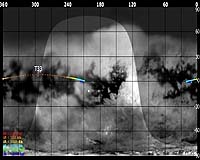
This Friday, 29 June 2007, Cassini returns to Titan for its thirty-fourth targeted encounter with Saturn's largest moon: Titan-33. The closest approach occurs at 16:59:46 UT, at an altitude of 1932 kilometres above the surface and at a speed of 6.2 kilometers per second. The latitude at closest approach is 8.1N and the encounter occurs on orbit number 47. This encounter is set up with two manoeuvres: an apoapsis manoeuvre on 21 June, and a Titan approach manoeuvre on 26 June. This is the last in a series of nine outbound Titan encounters and occurs less than two days after closest approach to Saturn.
Science Highlights
Radio Science Subsystem (RSS)This is the third of three RSS Titan flybys in the nominal mission and two in the extended mission, covering a range of high and low inclination orbits near Titan's apoapsis and periapsis. It will be especially exciting to see what the T33 data reveal when combined with gravity passes during the earlier T11 (orbit 21) and T22 (orbit 36) flybys, while waiting for flybys T45 and T68. The flybys T11 and T22 were both at Titan apoapsis and provided consistent values of J2 and C22 (numbers that describe the gravitational field). T33 occurs at Titan periapsis and will provide the first opportunity to determine a preliminary value of Titan's Love number. This number is determined by the effect of tidal forces exerted on the moon, or put otherwise: it measures the flexibility of Titan. The final determination of the Love number is expected to tell us whether or not Titan has an internal ocean
Cassini Plasma Spectrometer T33 is a polar and upstream encounter. Though some CAPS scientists find wake encounters more desirable, the upstream encounter allows a very good comparison to wake encounters such as T9. There will be good CAPS pointing for magnetospheric interaction, with corotation in view from closest approach-2 to closest approach+1 hour. There will be no turns during this interval, allowing for very stable CAPS pointing during this period. The lack of turns also simplifies data analysis over the several minutes needed to get a full 3-D distribution – no concern that the spacecraft is turning, which would complicate the analysis. The team anticipates a good data set for ionosphere and polar upsteam interactions
Ultraviolet Imaging Spectrograph (UVIS) The team will obtain spectral images of Titan in the EUV and FUV to map the aurora and dayglow, to map hydrocarbon absorption, and to measure scattering and absorption by aerosols in the stratosphere
Composite Infrared Spectrometer (CIRS) CIRS will perform high spectral resolution measurements of the atmosphere
Visual and Infrared Mapping Spectrometer (VIMS) VIMS will obtain a global composition map at nearly full illumination and will perform monitoring for cloud motion and formation. VIMS will be searching for spectral signatures of dune fields, liquid hydrocarbons, and water and methane frost
Imaging Science Subsystem (ISS) ISS will be performing high-resolution (120-240 m/pixel) imaging of the equatorial bright-dark boundary around 1N, 215-210W (low phase angle coverage – 20-15 degrees), and will do regional-scale (240-500 m/pixel) mapping of the equatorial bright-dark boundary around 1N, 210W (very low phase angle ~13)
