
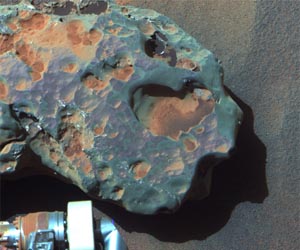
This is an image of the meteorite that NASA's Mars Exploration Rover Opportunity found and examined in September 2010. Opportunity's cameras first revealed the meteorite in images taken on Sol 2363 (Sept. 16, 2010), the 2,363rd Martian day of the rover's mission on Mars. This view was taken with the panoramic camera on Sol 2371 (Sept. 24, 2010).
The science team used two tools on Opportunity's arm – the microscopic imager and the alpha particle X-ray spectrometer – to inspect the rock's texture and composition. Information from the spectrometer confirmed that the rock is a nickel-iron meteorite. The team informally named the rock "Oilean Ruaidh" (pronounced ay-lan ruah), which is the Gaelic name for an island off the coast of northwestern Ireland.
Opportunity departed Oilean Ruaidh and resumed its journey toward the mission's long-term destination, Endeavour Crater, on Sol 2374 (Sept. 28, 2010) with a drive of about 100 meters (328 feet).
The component images were taken through three Pancam filters admitting wavelengths of 753 nanometers, 535 nanometers and 432 nanometers. This view is presented in false color to make some differences between materials easier to see.
earlier related report
Thumbs Up Given for 2013 NASA Mars Orbiter
PASADENA, Calif. – NASA has given a green light for development of a 2013 Mars orbiter mission to investigate the mystery of how Mars lost much of its atmosphere: the Mars Atmosphere and Volatile Evolution (Maven) mission.
Clues on the Martian surface, such as features resembling dry riverbeds and minerals that only form in the presence of liquid water, suggest that Mars once had a denser atmosphere, which supported the presence of liquid water on the surface.
As part of a dramatic climate change, most of the Martian atmosphere was lost. Maven will make definitive scientific measurements of present-day atmospheric loss that will offer insight into the Red Planet's history.
Approval to proceed with development followed a review at NASA Headquarters of the detailed plans, instrument suite, budget, and risk factor analysis for the spacecraft.
Share This Article With Planet Earth
