
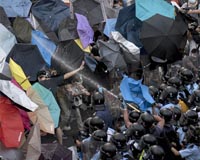
A Hong Kong police officer shot a masked protester in an incident shown live on Facebook Monday while a man was set alight, during one of the most violent days of clashes seen since pro-democracy unrest erupted more than five months ago.
Protesters, who had already begun a city-wide day of action aimed at paralysing the international financial hub, reacted to the morning shooting by rampaging through train stations, barricading streets and vandalising shops.
A masked assailant also doused a man with a flammable liquid and set him ablaze during an argument. The horrifying scene was captured on mobile phones and quickly went viral.
Police said a protester carried out the attack, and accused black-clad "rioters" of an array of other violent acts, including throwing a petrol bomb inside a train carriage.
Protesters voiced fury at what they said was excessive force used against them.
"Continuing this rampage is a lose-lose situation for Hong Kong," police spokesman John Tse said at a press conference in which he showed the video of the man being set alight, as well as a fire inside a train.
The footage of the shooting — broadcast live to Facebook by a bystander — showed a police officer drawing a pistol as he tried to detain a masked person at a junction that had been blocked by protesters.
Another unarmed masked individual then approached the officer and was shot, quickly falling to the ground.
Seconds later, two more live rounds were fired as the officer scuffled with another masked protester, who fell to the floor. Both were detained by officers.
A pool of blood could be seen near the first man, whose body initially appeared limp, although he was later filmed conscious and even trying to make a run for it.
The second man was conscious, shouting his name to reporters as he was handcuffed.
Hong Kong police confirmed one person was struck by a bullet, while hospital authorities said a 21-year-old man was admitted with a gunshot wound.
The man attacked by being set alight was taken to hospital in a critical condition, according to Tse.
– Increasing violence –
Hong Kong has endured 24 straight weeks of increasingly violent rallies aimed at securing greater democratic freedoms from China, which has ruled the city under a "one country, two systems" framework since its handover from the British in 1997.
The protesters are desperate to stop what they see as Beijing's tightening control over Hong Kong and its reneging on its handover commitment to allow greater liberties for the city than those on the mainland.
But Beijing has refused to give in, and instead warned it is prepared to impose even greater security measures.
Protesters have been incensed at what they see as police brutality and Monday's shooting only fuelled the tinderbox atmosphere.
"I don't understand why the police has to use that kind of brutality to hurt innocent people. I think it's just out of sense, out of control," a 22-year-old IT worker, who gave her surname as Chan, told AFP as she joined angry crowds in Sai Wan Ho after the shooting.
Monday's shooting was the third time protesters had been shot with live rounds by police. None of the shootings have resulted in deaths.
Tensions in Hong Kong were already high following the death on Friday of a 22-year-old student who succumbed to injuries sustained from a fall in the vicinity of a police clearance operation a week earlier.
After a weekend of clashes and huge vigils, Monday's chaos began with small groups of masked protesters hitting subway stations and roads during the rush hour commute.
But as footage of the shooting went viral, the protests snowballed.
During the lunchtime break in Central, a downtown district that hosts blue-chip international conglomerates and luxury retailers, police fired tear gas to disperse thousands of protesters, many dressed in office attire, chanting "murderers" and "Triads".
Tear gas and rubber bullets were fired in multiple districts throughout the morning, including at two university campuses.
One video circulated by protesters on messaging channels showed a police officer trying repeatedly to drive his motorbike into protesters who had gathered on a road.
Hong Kong: five months of unrest
Hong Kong (AFP) Nov 11, 2019 –
Hong Kong's pro-democracy protests erupted into violence in June, plunging the former British colony into its most severe crisis since it reverted to Chinese rule in 1997.
After one of the most violent days of clashes since the start of the unrest, here is a recap of five months of unrest.
– First clashes –
In the semi-autonomous territory's biggest demonstration since 1997, more than a million people, according to organisers, march on June 9 to protest a draft government bill that would allow extradition to mainland China.
Violence erupts when pockets of protesters fight running battles with police.
A new demonstration on June 12 sees the worst clashes since the handover.
Police use tear gas, rubber bullets and batons against demonstrators. Dozens are injured and one protester dies falling from a roof.
– Two million protesters –
Hong Kong leader Carrie Lam suspends work on the bill on June 15 but a demonstration the next day calls for its full withdrawal.
Organisers say two million people take part in a city of 7.3 million.
On July 1, the anniversary of Hong Kong's return to China, hundreds of protesters smash their way into parliament and ransack the building.
– Authorities get tough –
On July 21, masked, stick-wielding government supporters — suspected to be triad gangsters — beat protesters in a train station.
July 27 and 28 see running battles between riot police and protesters.
The local authorities and Beijing toughen their stance and dozens are arrested.
On August 5 a strike brings the city to a standstill.
– Airport chaos –
Hong Kong's airport cancels flights on August 12 after being invaded by thousands of black-clad protesters.
On August 15 thousands of Chinese military personnel parade in Shenzhen, just across the border.
– First gunshot –
On August 25 police for the first time use water cannon and fire a warning shot after clashes in which protesters throw bricks and Molotov cocktails.
– Law shelved –
On September 4 Lam says the extradition bill is withdrawn, but the move is dismissed by activists.
– Violence intensifies –
September 29 sees the most intense confrontations in weeks.
On October 1, police for the first time shoot a pro-democracy protester, leaving him wounded. The violence overshadows China's celebrations of 70 years of Communist Party rule.
Lam invokes emergency powers on October 4 to ban protesters wearing face masks, but activists vow to defy the new law.
The government on October 29 bars leading activist Joshua Wong from running in local elections.
– New death –
On November 3, a man goes on a knife rampage, leaving at least five people wounded. Another knife attack takes place days later, and a pro-Beijing politician is wounded.
On November 7, in the city's first such case involving a mainlander, a Chinese student arrested at a pro-democracy protest in Hong Kong is sentenced to six weeks in prison for possessing an offensive weapon.
And on November 8, in the first student fatality, a Hong Kong student dies after sustaining head injuries when he fell during clashes with police five days earlier.
– Day of fury –
After a weekend of clashes, further chaos on November 11 develops into one of the most violent days of clashes since the start of the unrest.
A police officer shoots a masked protester in an incident shown live on Facebook. Demonstrators react by rampaging through train stations, barricading streets and vandalising shops.
A masked assailant also douses a man with a flammable liquid and sets him ablaze during an argument, with the horrifying scene captured on mobile phones and posted online.
