
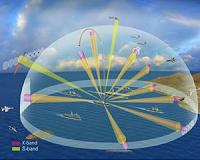
Raytheon's Air and Missile Defense Radar tracked a ballistic missile test target for the first time during a U.S. Navy exercise in Kauai, Hawaii.
During what the Navy praised as a successful demonstration, the system searched for, acquired and tracked its target. The event followed a series of trials for the system which examined its ability to track satellites and aircraft.
"We remain on track to deliver an unprecedented capability to the fleet," Raytheon's Tad Dickenson said in a press release. "The radar performed exactly as we expected it to during this mission – all systems were green."
Dickenson went on to add the event also verified the radar's major hardware and software components. U.S. Navy Captain Seiko Okano called the demonstration a historic moment for the service.
"It's the first time a ballistic missile target was tracked by a wideband digital beamforming radar," he said. "AN/SPY-6 is on track for delivery to DDG 51 Flight III."
Raytheon's Air and Missile Defense Radar, also referred to as AMDR or AN/SPY-6(Y), is a next-generation air and missile defense platform being developed for the Navy's DDF-51 Flight III destroyer. The system is designed to enhance ships' ability to detect air and surface threats, including ballistic missiles.
Once in service, the radar will be able to provide visuals for targets half the size at twice the distance as existing platforms, and provide 360 degrees of situational awareness. The product is over 30 times more sensitive than AN/SPY-1D(V) systems in the Flight III configuration.
U.S. Missile Defense Agency buys Lot 9 THAAD Interceptors
Lockheed Martin received a $273 million contract to produce Terminal High Altitude Area Defense Lot 9 Interceptors for the U.S. Missile Defense Agency.
Terminal High Altitude Area Defense systems, or THAAD, are defensive platforms used to engage incoming ballistic missile attacks and other airborne threats. The system is capable of intercepting missiles from inside and outside of the Ea … read more
