
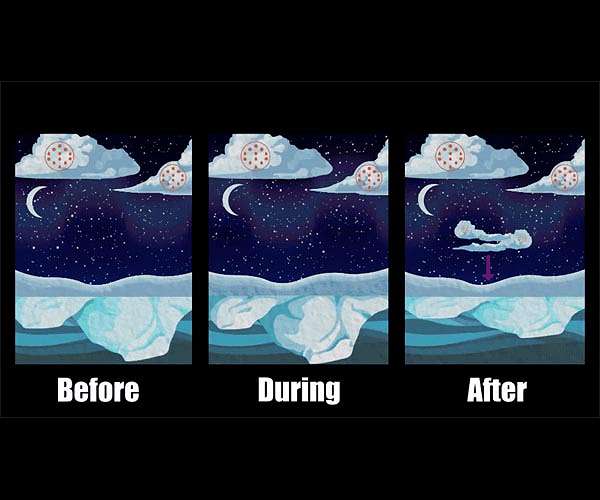
The Arctic is warming at a rate two to four times higher than the global average, revealing complex interactions between temperature changes and atmospheric conditions. A study by researchers in Japan highlights the role of Arctic dust, originating from snow- and ice-free areas, as a key factor influencing climate dynamics in the region. The findings were published in npj Climate and Atmospheric Science.
Traditionally, scientists believed that higher Arctic temperatures would lead to an increase in liquid droplets and a reduction in ice crystals within clouds. This process was thought to make clouds thicker and longer-lasting, enhancing their ability to reflect sunlight and cool the region during summer, a process termed "temperature feedback."
However, the recent study indicates that as Arctic warming melts snow and ice, it exposes more land surfaces, leading to a rise in dust emissions. This dust encourages the formation of ice crystals in clouds, potentially thinning and shortening their lifespan. Such changes reduce sunlight reflection, potentially heating the region – a phenomenon described as "emission feedback."
"Increasing amounts of dust due to Arctic warming may cause the opposite phenomenon of the conventional understanding of ice crystal changes," explained Associate Professor Hitoshi Matsui of Nagoya University, lead author of the study. "Our previous study found that a large amount of Arctic dust is distributed in the lower troposphere (below about 3 km altitude) over the region in summer and early fall, with the dust acting as a very efficient nucleus for ice formation in clouds at this altitude during the season."
To better understand the effects of Arctic dust on cloud formation, Matsui, along with Dr. Kei Kawai and collaborators from the National Institute of Polar Research and Hokkaido University, used the CAM-ATRAS global aerosol-climate model.
Their research analyzed 40 years of Arctic dust emissions data from 1981 to 2020, showing a 20% increase in emissions during this period. The simulations revealed that this rise in dust promoted ice nucleation in the lower troposphere, counteracting the expected reduction in ice crystals caused by higher temperatures. The effect of dust emissions outweighed the temperature feedback in 30% of the region annually and 70% during summer months.
"Most climate models have not considered the effects of dust from the Arctic land surface," Matsui added. "Our research suggests that the counterbalancing temperature and emission feedbacks should be considered to improve the accuracy of climate change predictions in the Arctic."
Research Report:Increasing Arctic dust suppresses the reduction of ice nucleation in the Arctic lower troposphere by warming
