
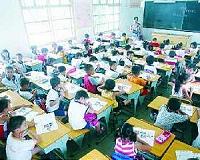
The Chinese kindergarten children giggled as they worked to solve puzzles assigned by their new teaching assistant: a roundish, short educator with a screen for a face.
Just under 60 centimetres (two feet) high, the autonomous robot named Keeko has been a hit in several kindergartens, telling stories and challenging children with logic problems.
Round and white with a tubby body, the armless robot zips around on tiny wheels, its inbuilt cameras doubling up both as navigational sensors and a front-facing camera allowing users to record video journals.
In China, robots are being developed to deliver groceries, provide companionship to the elderly, dispense legal advice and now, as Keeko's creators hope, join the ranks of educators.
At the Yiswind Institute of Multicultural Education on the outskirts of Beijing, the children have been tasked to help a prince find his way through a desert — by putting together square mats that represent a path taken by the robot — part storytelling and part problem-solving.
Each time they get an answer right, the device reacts with delight, its face flashing heart-shaped eyes.
"Education today is no longer a one-way street, where the teacher teaches and students just learn," said Candy Xiong, a teacher trained in early childhood education who now works with Keeko Robot Xiamen Technology as a trainer.
"When children see Keeko with its round head and body, it looks adorable and children love it. So when they see Keeko, they almost instantly take to it," she added.
Keeko robots have entered more than 600 kindergartens across the country with its makers hoping to expand into Greater China and Southeast Asia.
Beijing has invested money and manpower in developing artificial intelligence as part of its "Made in China 2025" plan, with a Chinese firm last year unveiling the country's first human-like robot that can hold simple conversations and make facial expressions.
According to the International Federation of Robots, China has the world's top industrial robot stock, with some 340,000 units in factories across the country engaged in manufacturing and the automotive industry.
The service robot market — which includes devices ranging from specialised medical equipment to automated vacuum cleaners — is estimated to be worth $1.32 billion last year.
It is expected to grow to $4.9 billion by 2022, said market research firm Research In China.
Last week, Beijing hosted the World Robot Conference, featuring machines that can diagnose diseases, play badminton and wow audiences with their musical skills.
– Robocompanion –
Last year, a group of monks in Beijing created a two-foot-high robot monk dispensing mantras and advice to attaining nirvana.
The iPal — a companion of sorts for children — is the latest humanoid robot to be marketed for family use, following in the footsteps of the diminutive, wisecracking "Pepper" companion released by Japan's SoftBank in 2015.
But Xie Yi, principal of the kindergarten where Keeko has been put on trial, believes that it will be a long while before robots can completely replace humans in the classroom.
"To teach you must be able to interact, have a human touch, eye contact and facial expressions. These are the things that make an education," Xie said.
"It's not just the language or the content, it's everything."
She said the Keeko robots, which cost about 10,000 yuan ($1,500), or about the monthly salary of a kindergarten teacher, may have some advantages over a flesh-and-blood educator.
"The best thing about robots? They're more stable (than humans)," she said with a laugh.
Rights groups urge Google not to bend to China censors
San Francisco (AFP) Aug 28, 2018 –
Human rights groups and other advocacy organizations Tuesday urged Google to abandon any plans to craft a censored version of its search engine that could pass muster with regulators in China.
A reported Dragonfly project, which Google has not publicly confirmed, "would represent an alarming capitulation by Google on human rights," argued a letter signed by 14 groups including Amnesty International, Human Rights Watch, and Reporters Without Borders.
Google employees and whistle-blowers speaking out against the project should be protected by the Silicon Valley-based company, the groups said.
"Google risks becoming complicit in the Chinese government's repression of freedom of speech and other human rights in China," the letter read.
"Google should heed the concerns raised by human rights groups and its own employees and refrain from offering censored search services in China."
Cynthia Wong of Human Rights Watch said Google "has failed to explain how it will shield users from the Chinese government's efforts to monitor and suppress dissent."
Google withdrew its search engine from China eight years ago due to censorship and hacking but it is now working on a project for the country codenamed Dragonfly, an employee told AFP on condition of anonymity.
The search project — which works like a filter that sorts out certain topics — can be tested within the company's internal networks, according to the worker.
Although Google has not commented publicly on the plans, some reports said the company has described the effort as exploratory.
"We provide a number of mobile apps in China, such as Google Translate and Files Go, help Chinese developers, and have made significant investments in Chinese companies like JD.com," spokesman Taj Meadows told AFP when news of Dragonfly broke early this month.
"But we don't comment on speculation about future plans."
US internet titans have long struggled with doing business in China, home of a "Great Firewall" that blocks politically sensitive content, such as the 1989 Tiananmen massacre.
Twitter, Facebook, YouTube and The New York Times website are blocked in China, but Microsoft's Bing search engine continues to operate.
Other organizations signing the letter include Access Now, Article 19, the Center for Democracy and Technology, the Committee to Protect Journalists, Electronic Frontier Foundation, Human Rights in China, International Service for Human Rights, PEN International, Privacy International and Witness.
