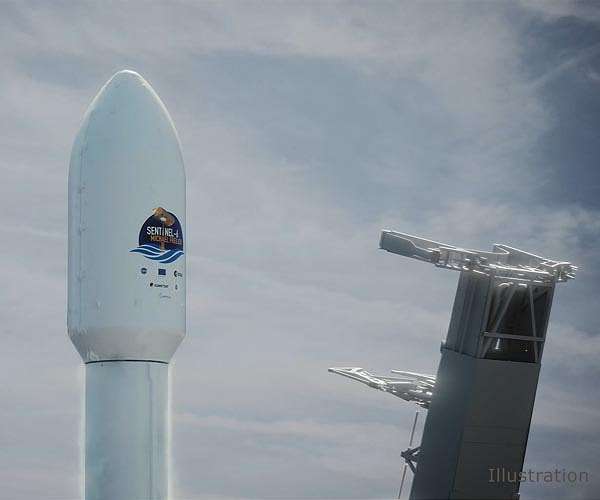
Sentinel-6 Michael Freilich, the latest in a series of spacecraft designed to monitor our oceans, was launched from Vandenberg Air Force Base in central California on Saturday, Nov. 21, 2020. The satellite will be followed in 2025 by its twin, Sentinel-6B.
Together, the pair is tasked with extending our nearly 30-year-long record of global sea surface height measurements. Instruments aboard the satellites will also provide atmospheric data that will improve weather forecasts, climate models, and hurricane tracking.
Launch Timeline
Named after former NASA Earth Science Division Director Michael Freilich, the U.S.-European satellite was carried into space on a SpaceX Falcon 9 rocket, with liftoff targeted for 9:17:08 a.m. PST (12:17:08 p.m. EST) from Space Launch Complex 4 East.
A little more than two minutes after the Falcon 9 rocket lifted off, the main engine cut off. Shortly after, the rocket's first and second stages separateed, followed by second-stage engine start. The reusable Falcon 9 first stage then began its automated boost-back burn to the launch site for a successful propulsive landing.
The first cutoff of the second stage engine took place approximately eight minutes after liftoff. It will fire a second time 45 minutes later, at which point the launch vehicle and the spacecraft will be in a temporary "parking" orbit. Several minutes later, the launch vehicle and the spacecraft will separate. The satellite will begin solar panel deployment about one hour and seven minutes post-launch and is expected to make first contact about 25 minutes after that.
Sentinel-6 Michael Freilich and Sentinel-6B make up the Sentinel-6/Jason-CS mission, which was developed by ESA (European Space Agency) in the context of the European Copernicus program led by the European Commission, the European Organisation for the Exploitation of Meteorological Satellites (EUMETSAT), NASA, and the National Oceanic and Atmospheric Administration (NOAA), with funding support from the European Commission and technical support from France's National Centre for Space Studies (CNES).