
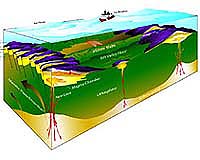
A dark green, unusually soft layer of rock known as serpentine, which coats tectonic plates, plays a key role in the emergence of powerful earthquakes, a US-French study said Thursday.
Serpentine forms deep in the ocean, up to 200 kilometers below the surface, home to some of the world's deadliest earthquakes such as the massive 9.0-magnitude quake that triggered the devastating tsunami off Indonesia in December 2004.
The soft rock, which can form under or over the ocean's crust, is also present in other areas of high volcanic and seismic activity in the Caribbean and Japan, according to the study published in the December 21 edition of the journal Science.
The rocks on the ocean bottom are usually rigid, but they can behave like fluids under extremely high temperatures and pressures, the study said.
But these rocks can break during tectonic plate movements in frigid waters, causing an earthquake, according to the study conducted by scientists from the CNRS lab at Lyon University along with other French and American researchers.
