
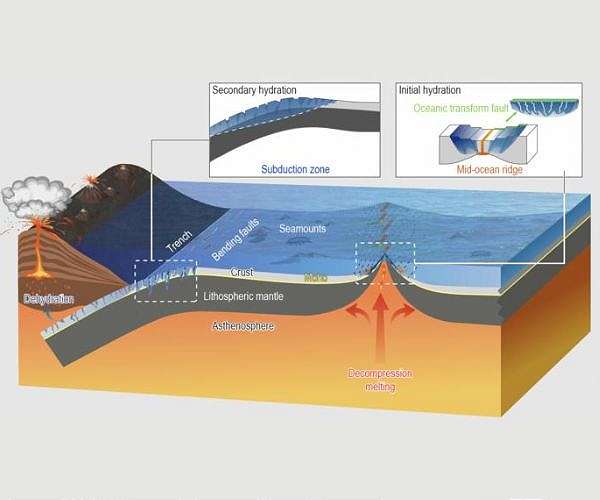
A recent study has shed new light on the enigmatic origins of natural spa waters, revealing a connection to ancient waters trapped deep within the Earth's lithosphere. This research, which analyzed the stable isotope compositions of hydrogen and oxygen in water molecules, has uncovered characteristics indicating the presence of long-trapped lithospheric water, distinct from the more commonly known meteoric sources like rain and snow.
The researchers employed sophisticated numerical modeling to trace the isotopic evolution of this water. They found that various types of water, such as those found beneath the seafloor, in submarine mud volcanoes, coastal oil field brines, and volcanic steam from plate subduction zones, share a common evolutionary trajectory. This groundbreaking approach has allowed for a deeper understanding of the complex, three-dimensional structure and evolution of ultra-deep water circulation, extending over 100 kilometers deep.
Furthermore, the team developed an innovative method for reconstructing the original isotopic composition of lithospheric water. This technique effectively eliminates the effects of meteoric water contamination from the isotopic data of natural spa waters. Using this method, the researchers calculated the isotopic composition of lithospheric waters at the depths of various spa sites and compared these values with those reconstructed from natural spa waters.
The geographical distribution of spa waters was categorized into three groups based on their isotopic evolution. These categories are aligned with the subduction of the Philippine Sea Plate or the Pacific Plate, or they show minimal isotopic evolution, not aligning with either plate. This categorization is not just a scientific curiosity but has profound implications for our understanding of the role of water in seismic and volcanic activities.
The study's findings are vital for the prediction and forecasting of earthquakes and volcanic eruptions. Understanding the intricate relationships between deep-seated water sources and tectonic activities provides a new lens through which to view the dynamics of the Earth's interior. This research intersects geology, hydrology, and geophysics, offering fresh perspectives on the ancient cycles of water deep within our planet.
Research Report:Isotopic evolutionary track of water due to interaction with rocks and its use for tracing water cycle through the lithosphere
