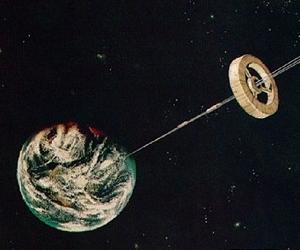
A space elevator is a concept that promises to permit launching spacecraft into orbit without the use of a launch vehicle. In theory, it is a structure that can transport objects from the Earth's surface upward and into space. Although many elevator variants have been proposed, they all involve travelling vertically along a fixed cable or ribbon made of super-strength materials under non-rocket power.
Physics tells us that this structure must extend from a point on the equator up to, and well beyond, the geostationary orbit. At the end of the cable or ribbon there must be a counter-mass to insure sufficient tension forces through centrifugal acceleration, due to the Earth's rotation. Heights of up to 65,000 km have been suggested. The space elevator has been proposed as a launching mechanism for geostationary satellites and for spacecraft travelling beyond Earth.
Space elevator physics seems straightforward. None of the basic laws of mechanics seems to be violated. And, this concept seems to be a great motivator for innovative thinking, especially in universities and among advanced thinkers. But, if physical principles are satisfied, is the space elevator fact or fiction?
Let's look at it from an engineering point of view. Start with a review of materials. Conventional materials, such as steel, are not strong enough. New materials, such as carbon nanotubes, have been suggested since they appear to offer sufficient strength-to-mass to make this possible.
However, such materials are still in early stages of development and no large structures have as yet been built. There will be a huge power requirement in order to lift large objects from the Earth's surface. Self-contained power sources appear far-fetched, but ground-based lasers have been proposed. However, such laser-power-transfer systems have never been built.
Next, there is the orbital interaction with free-flying satellites and debris. Since the elevator will pass through virtually all of the altitudes of active Earth satellites and resident space objects, there is a 100% probability that the elevator will experience collisions throughout its life. Impact speeds will be as high as 8 km/sec. Imagine an expired LEO satellite with a mass of a SUV running into the elevator cable at 28,000 km/hr. Ouch!
What about safety, stability and control of the elevator system? There are huge issues regarding the safety of personnel and property. For example, if the cable were to snap near the geostationary altitude, there would be 35,000 km of cable falling and possibly wrapping itself around the equator.
This is almost long enough to go around the Earth. You would not want to be under the cable, nor would you want to be the one to clean it up afterward. Furthermore, we do not know whether the elevator is dynamically stable, nor how to control a 65,000-km-long structure.
The space elevator is surely an interesting idea, but it still has a technology readiness level that is near zero.
Share This Article With Planet Earth