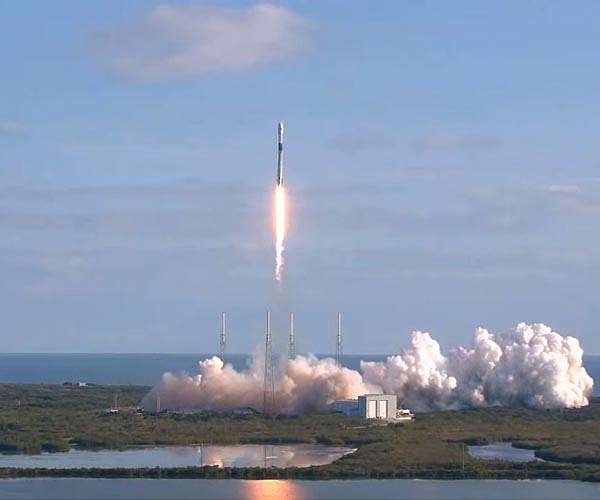
SpaceX on Sunday launched its Falcon 9 rocket carrying a record number of satellites on board, the private space company said.
The rocket successfully launched from Cape Canaveral, Florida at 10:00 am (1500 GMT), 24 hours after its initial take-off had been scrubbed due to bad weather.
Andy Tran, a SpaceX production supervisor, said in a video of the launch that the Falcon 9 was carrying 133 commercial and government "spacecraft" as well 10 SpaceX satellites.
"The most spacecraft ever deployed on a single mission," Tran said.
SpaceX is flying Falcon 9 under a "rideshare" program through which other firms and governments pay the Elon Musk-founded company to deliver their technologies to space.
Minutes after taking off, the Falcon 9's main booster that had thrust the rocket to the edge of space separated from the rest of the craft and dropped back down to Earth in a controlled fall.
It landed itself on an unmanned spaceport drone ship called "Of Course I Still Love You" in the Atlantic Ocean, marking the booster's fifth successful deployment and recapture.
In a series of tweets, SpaceX said all 143 satellites had been successfully deployed.
SpaceX aims to send thousands of small satellites into space to form a global broadband system called Starlink.
Scientists have expressed concerns about the number of objects clogging the space around Earth. SpaceX say their satellites are designed to burn up in the atmosphere within a few years.
pre launch report
SpaceX plans record-breaking launch with 143 satellites
Washington DC (UPI) Jan 22, 2021 –
SpaceX plans to launch the most satellites ever deployed in a single mission, 143, on Saturday morning from Florida for more than a dozen customers.
A 2017 mission by the India Space Research Organization launched 104 spacecraft, which would be the previous record if the SpaceX launch is a success.
Liftoff aboard a Falcon 9 rocket from Cape Canaveral Space Force Station is planned for at 9:40 a.m. EST, but could come up to 42 minutes later in case of a problem.
The mission has been postponed several times dating to mid-December. A U.S. Space Force forecast shows a 40 percent chance that thick clouds could prompt another delay.
The Transporter-1 mission is the first in a series of regularly scheduled SpaceX rideshare projects for multiple customers. SpaceX also plans to carry 10 of its Starlink communications satellites on this mission.
"The Starlink satellites aboard this mission will be the first in the constellation to deploy to a polar orbit," according to the SpaceX mission description. Polar orbits circle the globe by passing over the North Pole and South Pole, while many satellites circle above equatorial regions.
Houston-based space firm Nanoracks is acting as a broker to arrange some customers for the launch, said Tristan Prejean, a mission manager at Nanoracks.
"SpaceX will be offering several Transporter missions per year moving forward," Prejean said. "The orbital parameters and launch timeline were the exact opportunities our customers were looking for."
Nanoracks' two customers for Transporter-1 are two satellite companies, California-based Spire Global and Montreal-based GHGSat.
Spire launches fleets of small satellites that monitor weather and patterns for shipping for aviation interests. GHGSat monitors industrial emissions of gasses from space — especially greenhouse gases that contribute to climate change.
These rideshare missions offer lower costs to reach orbit, but don't allow much flexibility for time of launch and orbital location, said Phil Smith, senior analyst at Bryce Space and Technology, a Virginia-based space research firm.
"SpaceX is making a significant impact on satellite deployment with these missions," Smith said. "Traditionally, large satellites have needed a dedicated rocket where the operator can pick the time and orbit, but satellites have been shrinking dramatically for years now."
Some of the satellites for Transporter-1 are known as CubeSats or even nano-satellites — no bigger than a shoebox.
The cost of such rideshare missions is much lower, Smith said — as low as $2,000 for just over 2 pounds compared to around $30,000 for a launch for a single customer.
A growing number of launch opportunities provides more flexible and timely schedules to replace aging satellites or launch new ones, said Claude Rousseau, senior analyst with Northern Sky Research based in France.
SpaceX rideshare missions "certainly provide more options for small-sat satellite operators to launch and rideshares on heavy launchers are gaining traction at the moment," Rousseau said.