
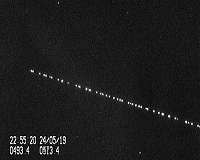
paceX is developing Starlink, a satellite constellation that uses a low-cost, high-performance satellite bus and required user ground transceivers. Services to be provided include new space-based Internet communications.
SpaceX initially planned to deploy nearly 12,000 satellites, but has now increased this number by 30,000, adding up to 42,000 satellites. The initial 12,000 satellites are to be placed in three orbital shells by the mid-2020s. The first 1,600 units are to be placed in a 550-km altitude shell.
The next 2,800 satellites are going into a 1,150-km shell. Finally, approximately 7,500 units are destined for placement at 340 km. Add to this a few spares and you get about 12,000 satellites. The estimated cost of this initial project is $10 billion.
In February 2018, two prototype satellites were launched. In May of this year the first large deployment of 60 operational satellites took place. Initial commercial operations should begin next year.
Most recently, SpaceX applied for spectrum approval from the International Telecommunication Union for 30,000 additional Starlink satellites. Needless to say, SpaceX is planning the world's largest low-Earth-orbit (LEO) constellation with approximately 42,000 satellites.
It is interesting to note that the United Nations Office for Outer Space Affairs has indicated that approximately 8,500 spacecraft and space station flight elements have been launched into space since 1957. There are currently some 1,500 active satellites in LEO.
Thus, if SpaceX does launch 42,000 Starlink satellites into near-Earth orbits, this would represent a 28-fold increase to the active-satellite population. Obviously, concerns have been raised about the long-term danger of space junk resulting from thousands of satellites in orbits above 700 km, where orbit decay times are measured in hundreds-to-thousands of years.
