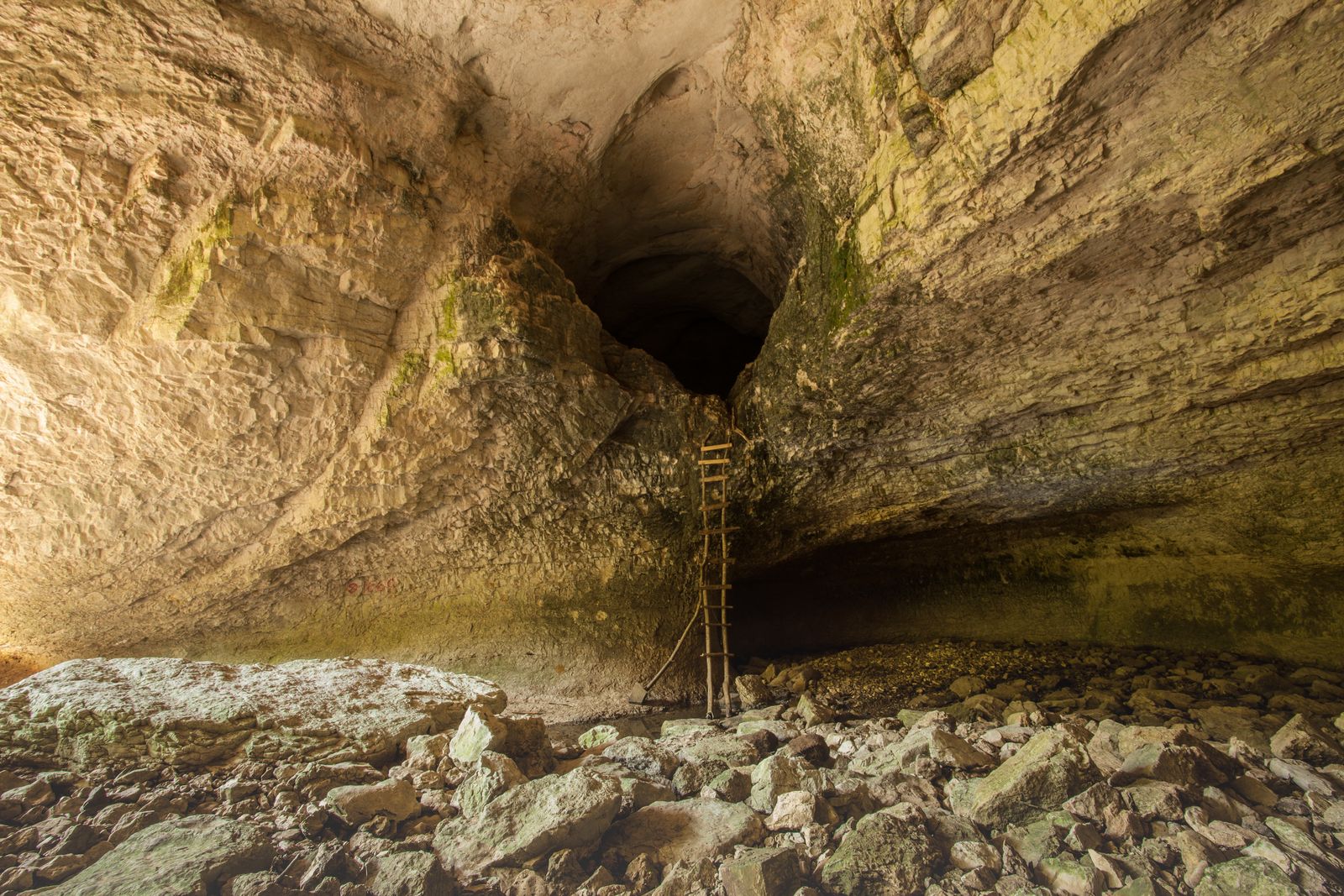
About 18 metres beneath a wheatfield in Constanța County, Romania, a limestone chamber holds an atmosphere no human lung could tolerate. The air inside Movile Cave carries only 7 to 10 percent oxygen — a third to a half of the 21 percent at the surface — along with carbon dioxide at roughly 100 times atmospheric levels, one to two percent methane, and a persistent haze of hydrogen sulphide and ammonia. Yet in that poisoned dark, 51 invertebrate species have been catalogued, 35 of them found nowhere else on Earth, feeding on a food web that begins not with a leaf but with a bacterium eating rock chemistry. The process is called chemosynthesis, and Movile was the first place on land where anyone found an entire ecosystem running on it.
The cave was cut open by accident in 1986, when Romanian workers probing the ground for a power plant site near the town of Mangalia drilled into it. The speleologist Cristian Lascu was the first person to descend. What he found was a 240-metre horizontal maze with no natural entrance, sealed beneath thick, impermeable layers of clay and loess. The isolation is conventionally dated to the late Miocene, on the order of 5.5 million years. That number is an interpretation drawn from the geology and the divergence of the endemic species, not a stopwatch reading. But the biology inside is unambiguous: nothing in Movile lives on sunlight.
A cave the surface forgot
Movile sits in the Dobrogea plateau, a few kilometres inland from the Black Sea. Above it lies an impermeable cap of clay and loess. That cap is the reason the cave has stayed cut off. Rainwater cannot percolate through it in any meaningful volume, so the chamber below never received the drip of leaf litter, bat guano, or dissolved organic carbon that feeds almost every other cave ecosystem on the planet.
What did seep in, from below, was sulphidic groundwater. A thermal aquifer pushes warm, mineral-rich water up through fractures in the limestone. Where that water meets the cave air, hydrogen sulphide gas comes out of solution. The result is a still, humid, 21°C atmosphere at essentially 100 percent relative humidity with no detectable air movement — and with H₂S concentrations that would trigger evacuation in any industrial workplace.
The dating rests on three things, none of them a calendar. The first is the timing of speleogenesis itself: the cave was dissolved out of the limestone by sulphuric acid generated when sulphide oxidises, a process that began in the late Miocene and continues today. The second is the impermeable seal, which cuts the chamber off from surface water and surface carbon. The third is the genetic and morphological divergence of the animals inside from their nearest surface relatives.
The honest complication is that these lines do not agree perfectly. Some accounts of the seal itself place it later, in the Quaternary, and the species-level evidence suggests the fauna is not all the same age — the cave’s blind water scorpion appears to be a comparatively recent arrival rather than a founder trapped 5.5 million years ago. Colonisation may have come in pulses, the Messinian salinity crisis first and later glacial episodes after it.
The seal is also not perfect. Trace amounts of oxygen dissolve into the groundwater and reach the cave from below. That oxygen is what allows the sulphide-oxidising bacteria to run their reaction at all — the whole system is driven by the meeting of reduced compounds from deep water and oxidised ones from a thin veneer of surface influence. The cap keeps the biology in. It does not keep the geochemistry out.
Chemistry instead of sunlight
On the surface of the lake that fills the lowest galleries, and along the damp limestone walls, floats a pale, spongy film. To the eye it looks like wet paper. It is the base of the entire food web. These mats are built by chemolithoautotrophic microorganisms that harvest energy by oxidising hydrogen sulphide and, in some cases, methane and ammonia. They use that energy to fix carbon dioxide into sugars, exactly as a leaf does with photons, only the electron donor is a poison rather than a photon.
The reaction is elegant, and it is self-excavating. Sulphide plus oxygen, mediated by filamentous bacteria of genera such as Thiothrix and Beggiatoa, yields sulphuric acid and biomass. The acid eats the walls. The biomass feeds everything else. The animals live inside a room their own food supply is slowly enlarging.
Sequencing work on the cave’s microbial communities, sampled across sublocations over three years, has mapped how sharply the chemistry shifts from the dry upper passages to the submerged air-bells, where methane and carbon dioxide climb and oxygen falls to the bottom of its range. The lake itself holds only a trace of dissolved oxygen in the top few centimetres and is completely anoxic below that.
In Movile, the bacterial mats are grazed by springtails, isopods, and aquatic worms. Those in turn are eaten by pseudoscorpions, water scorpions, centipedes, and a blind, pigment-free leech, Haemopis caeca, that hunts in the sulphidic pools. Every animal in the cave, from the smallest nematode to the top predator, carries a carbon signature that traces back to sulphide-oxidising microbes, not to plants.
Thirty-five species that exist nowhere else
The endemism inside Movile is what makes it more than a curiosity. Of the 51 invertebrate species so far identified, 35 are found only in this cave and its associated aquifer. They include a water scorpion, Nepa anophthalma, that has lost its eyes and is the only cave-adapted water scorpion known anywhere; a blind spider, Agraecina cristiani, originally described in the genus Lascona and named for Lascu himself; and, described as recently as 2020, a venomous centipede, Cryptops speleorex, that reaches 52 millimetres and is by a wide margin the largest animal yet found down there. Its name means cave king.
Most are translucent, the pigment cells that would tint them on the surface having gone unused for so long that natural selection stopped paying for them. Twenty-three of the endemic terrestrial species belong to just four classes — arachnids, crustaceans, myriapods, and insects — a narrow taxonomic base carrying an extraordinary amount of evolutionary novelty.
The animals have also lost the ability to survive above ground. Their metabolisms are tuned to low oxygen. Their cuticles are thin and prone to desiccation. Some tolerate H₂S concentrations that would kill their nearest surface relatives within minutes.
Roughly thirty people have ever been inside. Entry is restricted by the Romanian authorities and mediated through the Emil Racoviţă Institute of Speleology, and visits run to five or six hours at most. The reason is not danger to the visitor — although the air requires breathing apparatus — but danger to the cave. A single introduced microbe, a single boot-print of surface soil, could destabilise an ecosystem that has evolved without any of the microbial competitors surface caves take for granted.
The vulnerability is structural, not hypothetical. The entire food web depends on the steady flow of hydrogen sulphide from below and the steady seep of oxygen from above. Alter either, and the bacterial mats starve. Starve the mats, and everything above them follows. Septic leakage and sewage from the growing settlements overhead are the threats specialists name most often.
Not the only chemistry-fed cave
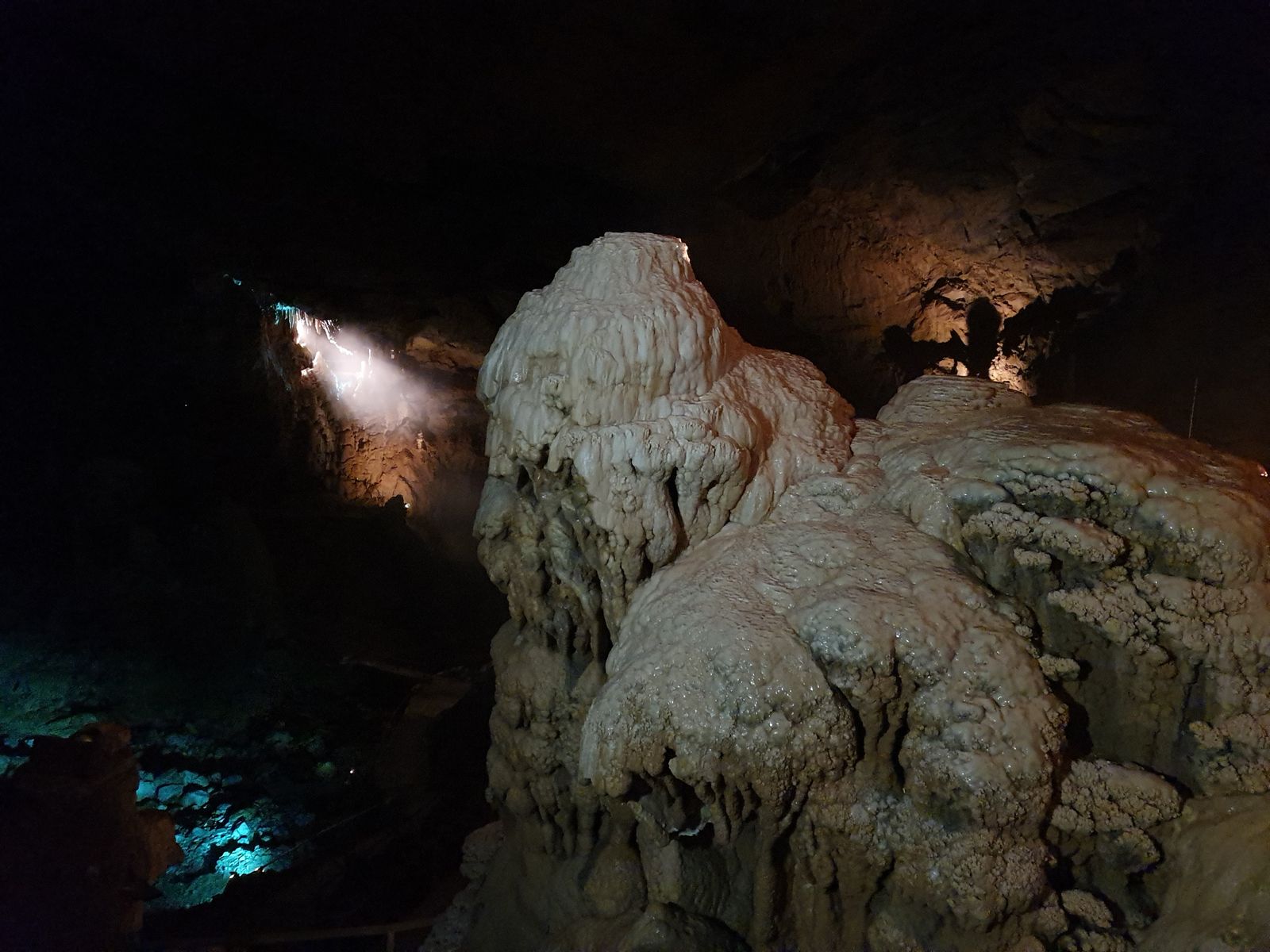
Movile is the most famous of the sulphidic caves, but it is not alone. Sulfur Cave, a 520-metre hypogenic passage in the Vromoner canyon on the Greek–Albanian border, was found by Czech cavers in 2022 and surveyed by biologists in 2023 and 2024. Its air carries up to 14 parts per million of hydrogen sulphide; a stream running through it holds a steady 26°C and H₂S concentrations reaching 65 milligrams per litre. White biofilms of Thiothrix and Beggiatoa coat the sediments.
On one wall, beginning about 50 metres from the entrance in a narrow, low-ceilinged and permanently dark stretch of passage, hangs a single sheet of interconnected funnel webs covering roughly 106 square metres. Inside it live an estimated 69,000 common house spiders (Tegenaria domestica) and more than 42,000 individuals of Prinerigone vagans. Both are ordinary surface species. Neither had ever been recorded forming a colony anywhere, and under normal conditions the first would prey on the second.
What holds it together is food. The webs sit under a hovering swarm estimated at more than 2.4 million non-biting midges, Tanytarsus albisutus, whose larvae graze the bacterial biofilms in the stream. Stable-isotope analysis of the spiders’ tissues traced their carbon and nitrogen back to those sulphur-oxidising microbes rather than to anything photosynthetic. DNA work found the cave populations genetically distinct from surface relatives nearby, with no sign of individuals moving between them, and their gut microbiomes markedly less diverse.
Their reproduction has shifted too. Clutch sizes inside the cave average in the mid-teens, small by comparison with published figures for surface populations, and vary seasonally — larger in early summer than in autumn or late winter. Fewer eggs, better provisioned, in a place where prey is abundant and predators are not.
Why chemistry, not sunlight, matters beyond Earth
The reason cave biologists and astrobiologists read each other’s papers is that Movile and Sulfur Cave are the closest analogues on Earth to what a subsurface ecosystem might look like on a world without a photosynthetic biosphere. Europa’s ice-covered ocean, Enceladus’s tiger-striped south pole, and the sulphate-rich subsurface of Mars all offer environments where sunlight is unavailable but redox chemistry is not. The question of whether life can be powered by rock–water reactions is not hypothetical here. It is answered, in Romanian limestone, every second.
Sulphidic speleogenesis has shaped significant cave systems elsewhere — the Frasassi complex in Italy, Lechuguilla in New Mexico — and the microbial machinery is broadly the same. What made Movile singular was catching the process with an intact, endemic ecosystem still running on top of it, a self-contained biosphere operating on a metabolism with almost nothing in common with the surface one a few metres above.
The practical difficulty is that these systems are hard to study without breaking them. Every entry is a contamination risk, every sampling campaign a small intervention in a closed room. The techniques being refined in Dobrogea and Vromoner — sterile gear, minimal residence times, sequencing from tiny samples — are the same problems any mission that eventually drills into an ice shell will have to solve.
A closed room, still running
Somewhere under the Dobrogea wheatfields, a leech is hunting a worm that ate a bacterium that ate a molecule of hydrogen sulphide that rose from an aquifer laid down when the Mediterranean was drying out. The lights have been off for something on the order of five million years. Modern humans have existed for roughly six percent of that span.
Whatever the exact number, the cave has been running its own chemistry, its own evolution, and its own quiet accounting of carbon and sulphur since long before anything on the surface would have recognised the sky above it.
The workers who drilled into the roof in 1986 were looking for solid ground to build a power station on. A few metres down, they found something already generating — no fuel delivered, no light admitted, no interruption in five million years.