
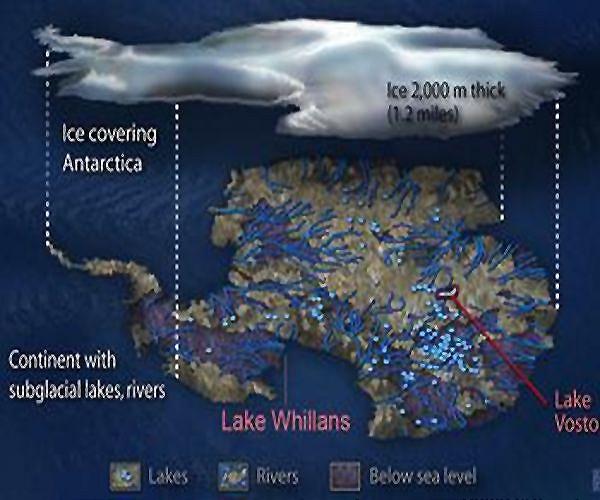
Life deep beneath Antarctica's ice sheets may be more common than previously thought.
According to a study published Wednesday in the journal Science Advances, subglacial lakes on the continent feature mixing sufficient to churn sediments and distribute nutrients and oxygen to resident microbes.
"The water in lakes isolated under the Antarctic ice sheet for millions of years is not still and motionless; the flow of water is actually quite dynamic, enough to cause fine sediment to be suspended in the water," lead researcher Louis Couston said in a press release.
Surveys suggests Antarctica's ice sheets are home to hundreds of subglacial lakes. Scientists have previously drilled into two small subglacial lakes, collecting water and ice samples from the meltwater inflow and outflow points.
The expeditions revealed the presence of microbes, but scientists still aren't sure whether microbial life can be sustained inside more expansive subglacial lakes.
Light can't penetrate to the depths where subglacial lakes are found. As such, microbes can't perform photosynthesis and must derive their energy from chemicals found in the sediment.
Some researchers have suggested most subglacial lakes are too stagnant to evenly distribute sediments and the nutrients they carry.
On Earth's surface, lakes are mixed by convection currents generated by the sun and winds. Deep beneath the Antarctica ice, there is no wind or sun to churn the water.
But according to a new model, geothermal energy left over from ancient geologic and tectonic activity should be enough to trigger thermodynamic mixing.
"With dynamic flow of water, the entire body of water may be habitable, even if more life remains focused on the floors," said Couston, a scientist at the University of Lyon and the British Antarctic Survey.
"This changes our appreciation of how these habitats work, and how in future we might plan to sample them when their exploration takes place," Couston said.
In the years ahead, Couston and his research partners plan to drill into larger lakes, including one called Lake CECs. The scientists hope to drill to a variety of depths to gauge exactly how widespread microbial life is.
"Our eyes now turn to predicting the physical conditions in liquid water reservoirs on icy moons and planets," said study co-author Martin Siegert.
"The physics of subglacial water pockets is similar on Earth and icy moons, but the geophysical setting is quite different, which means that we're working on new models and theories," said Siegert, a professor of glaciology at Imperial College London.
"With new missions targeting icy moons and increasing computing capabilities, it's a great time for astrobiology and the search for life beyond the Earth."
