
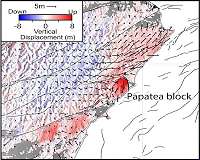
Thanks to a high-resolution simulation run by a supercomputer in Germany, scientists are learning new details about New Zealand's 2016 Kaikoura earthquake and its underlying geophysical processes.
The Kaikoura earthquake was one of the best documented earthquakes in history, but it was also one of the most unusual. To better understand the causes of the multi-segment earthquake, scientists in New Zealand, Germany and Hong Kong simulated the earthquake with unprecedented precision.
Researchers described their high-resolution earthquake simulation in the journal Nature Communications.
The perplexing complexity of the Kaikoura earthquake was product of its fragmented nature. Kaikoura featured ruptures of 20 segments of a fault network.
"Looking at the pattern of surface faults affected by the quake, one finds large gaps of more than 15 kilometers in between them," Alice-Agnes Gabriel, a geophysicist at the Ludwig Maximilian University of Munich, said in a news release. "Up to now, analyses of seismic hazard have been based on the assumption that faults that are more than five kilometers apart will not be broken in a single event."
Kaikoura's complex patterns weren't relegated to dry land. Though the earthquake originated on land, the ruptures triggered the largest tsunami in the region in several decades, suggesting the ruptures spread to ocean faults, displacing portions of the seafloor.
As a result of the research, scientists now have a better understanding of how complex successions of fault ruptures play out.
"This was made possible by the realistic nature of our model, which incorporates the essential geophysical characteristics of fault failure, and realistically reproduces how subsurface rocks fracture and generate seismic waves," said Gabriel.
The new models showed that Kaikoura's series of ruptures spread in a zig-zag fashion. While the speeds of individual ruptures were relatively quick, the succession of slips proceeded slowly across the fault network.
Prior to Kaikoura, scientists assumed only a large initial force could trigger such a complex and far-reaching succession of ruptures, but the latest research confirmed that Kaikoura's triggering force was relatively weak.
"The rupture of such a weakly loaded fault was boosted by very gradual slippage or creep below the faults, where the crust is more ductile and low levels of frictional resistance, promoted by the presence of fluids," Gabriel said. "In addition, high rupture velocities generally result in the rapid dissipation of frictional resistance."
Researchers hope their model will help scientists simulate the similar fault networks elsewhere. More accurate models of local fault networks can help scientists better predict the risk of future earthquakes.
Strong 6.1-magnitude quake jolts eastern Indonesia
Jakarta (AFP) March 24, 2019 –
A 6.1-magnitude earthquake hit off the coast of North Maluku province in eastern Indonesia Sunday, US seismologists said, but no tsunami warning was issued.
The quake was 150 kilometres (92 miles) northwest of the coastal town of Ternate at a depth of 37 kilometres, according to the US Geological Survey.
The quake was felt in Ternate but residents were unconcerned, a local said.
"I was watching TV when the earthquake suddenly happened, the jolt was quite strong but thankfully it was quick so there was no panic," Ternate resident Budi Nurgianto told AFP.
Officials are still assessing the quake's impact but there were no immediate reports of casualties.
"We are still checking to see if there's any damage," said Rahmat Triyono, head of Indonesian weather agency BKMG's earthquake and tsunami division.
Indonesia experiences frequent seismic and volcanic activity due to its position on the Pacific "Ring of Fire", where tectonic plates collide.
Last September, a 7.5-magnitude quake and a subsequent tsunami in Palu on Sulawesi island killed more than 2,200, with a thousand more declared missing.
On boxing day December 26, 2004, a 9.1-magnitude earthquake struck Aceh province, causing a tsunami and killing more than 170,000 in Indonesia.
