
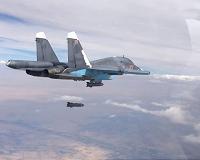
A surge in violence Saturday left 12 civilians dead in Syria's last major opposition bastion as aid groups warned of a humanitarian catastrophe if cross-border aid stops reaching the region.
Heightened regime and Russian bombardment on the northwestern province of Idlib since December 16 has already forced tens of thousands of vulnerable people to flee their homes, according to the United Nations.
The world body has called for "immediate de-escalation" and warned of further mass displacement if the violence continues.
The jihadist-dominated Idlib region hosts some three million people including many displaced by years of violence in other parts of Syria.
The Damascus regime has repeatedly vowed to take back the area and bombardment has continued despite a ceasefire announced in August.
Exacerbating an already dire humanitarian situation, Russia and China on Friday vetoed a UN Security Council resolution that would have extended for a year cross-border aid deliveries to four million Syrians, many of them in the Idlib region.
The move, slammed by the United States, raised fears that UN-funded assistance could stop entering opposition-held parts of Syria from January unless an alternative agreement is found.
US Secretary of State Mike Pompeo on Saturday described the Russian and Chinese veto as "shameful".
"To Russia and China, who have chosen to make a political statement by opposing this resolution, you have blood on your hands," he said.
Aid group Oxfam said people in need, many of them displaced several times, relied on the deliveries.
"There is no realistic way of reaching hundreds of thousands of these families" except though cross-border operations, a statement said.
Abu Zakour, a 70-year-old living in a camp in northern Idlib, voiced fears for the fate of the displaced if the deliveries were halted.
"Had it not been for the aid, we would have died from hunger," he said.
– 'Age of Impunity' –
The fears of an aid crisis came as violence intensified in Idlib.
On Saturday, air strikes by the Syrian regime and its ally Russia killed 12 civilians and wounded 36 others, said the Syrian Observatory for Human Rights, a Britain-based monitor.
That came on the third day of clashes between regime loyalists and Idlib militants that have killed nearly 140 on both sides, the Observatory said.
Battles since Thursday have killed 67 jihadists and 15 allied rebels, it added.
Fifty-seven regime loyalists were also killed, including at least seven who died Saturday in a car bombing by the country's former Al-Qaeda affiliate, Hayat Tahrir al-Sham (HTS), according to the monitor.
The Damascus regime, which controls 70 per cent of Syria, launched a blistering offensive against Idlib in April, killing around 1,000 civilians and displacing more than 400,000.
Since August, the area has supposedly been protected by a ceasefire announced by Moscow, but bombardment has continued.
– 'Last straw' –
A spike in violence this month highlighted the continued need for life-saving humanitarian aid, which currently flows into Syria through UN-designated checkpoints without formal permission from Damascus.
Four million Syrians directly benefit from the deliveries, among a total of 11 million receiving international aid inside the country eight years into its devastating war.
International Rescue Committee chief David Miliband warned Friday against scaling back humanitarian access.
"With a fresh spate of attacks in Idlib, and continued brazen flouting of international humanitarian law, cutting humanitarian aid is the last straw," he said.
The development could not come at a worse time of year, as heavy winter rains flood squalid camps for the displaced.
UN-supported aid organisations in northwest Syria say they may have to halt operations if cross-border support stops.
"This will paralyse the humanitarian effort in Syria's north," Maamoun Kharbout of the Violet Organisation, an aid group, told AFP.
Separately, near-simultaneous suspected drone attacks targeted three government-run oil and gas facilities in central Syria at dawn on Saturday, the oil ministry said.
There was no immediate claim of responsibility.
Russia, China veto UN extending Syria cross-border aid
United Nations, United States (AFP) Dec 20, 2019 –
Russia and China used their vetoes Friday to block a UN Security Council resolution that would have extended for a year cross-border humanitarian aid to four million Syrians.
Humanitarian aid currently flows into Syria through UN-designated checkpoints without the formal permission of the regime in Damascus, but that authority is due to expire on January 10.
Germany, Belgium and Kuwait presented a resolution extending that authority for a year, winning the support of 13 council members but drawing the vetoes of Russia and China.
A competing Russian resolution that would have granted a six-month extension while reducing the number of UN crossing points was rejected, having failed to get the minimum nine votes.
Russia is a close ally and major supporter of Syrian President Bashar al-Assad, and has used its veto 14 times on Syrian issues since the start of the civil war there in 2011.
Russia's ambassador to the United Nations, Vassily Nebenzia, said the latest resolution was "obsolete" because the authorities in Damascus have "retaken control of most" of Syria's territory.
But the UN humanitarian relief department says the aid remains crucial as the situation on the ground has deteriorated over the past year and Syria is heading into winter.
– 'State of shock' –
Four million Syrians directly benefit from the cross-border aid shipments while 11 million benefit from international aid after eight years of war.
"I am in a state of shock," Kelly Craft, the US ambassador, said after the Russian and Chinese vetoes.
"Today we took a huge step backwards in credibility where it really matters," she said.
"I am deeply and profoundly disappointed at the outcome of today's meeting."
Anne Gueguen, France's deputy permanent representative, called the Russian veto "irresponsible," insisting there was no alternative to providing aid across Syria's borders.
The latest resolution failed just as tens of thousands of civilians flee the northwestern Idlib region due to heavy bombardments by Assad's government, backed by Russia, in the last bastion of the jihadist opposition.
– Failure to compromise –
The text vetoed Friday called for a one-year extension of the authorization to ship humanitarian relief supplies into Syria — in effect since 2014 — through three checkpoints, two in Turkey and one in Iraq.
Hoping to overcome Russian opposition, the resolution's sponsors on Wednesday dropped a request for a fourth point of entry on the Jordanian border, which has hardly been used since 2018.
Earlier in the week, Russia offered a competing draft resolution calling for a six-month extension, but only via the two Turkish checkpoints.
Put to a vote Friday, that proposal was rejected, with the United States, France, Britain, Poland, Peru and the Dominican Republic voting against. Germany, Belgium, Kuwait and Indonesia abstained.
"If you're so concerned about Syria, then why didn't you vote in favor of the Russian draft?" said the Chinese ambassador, Zhang Jun.
But the British envoy, Karen Pierce, said that the vetoes showed an unwillingness to help Syrians.
"There is time to sort it out if everybody is willing to do so," she said.
"I found the crocodile tears from the Russians and Syrians about what will now happen on the ground merely yet another example of the breathtaking hypocrisy we have seen on this."
It was the second time in four months that Russia has vetoed a resolution dealing with the humanitarian situation in Syria.
In September, Moscow used its veto against a resolution calling for a ceasefire in Idlib. That resolution also was sponsored by Germany, Belgium and Kuwait.
Earlier Friday, the UN special envoy on Syria, Geir Pedersen, presented to the Security Council a grim picture as well on seeking a political solution in Syria.
A long-awaited committee to form a new constitution for Syria met in October in Geneva, but Pedersen acknowledged there was little progress.
