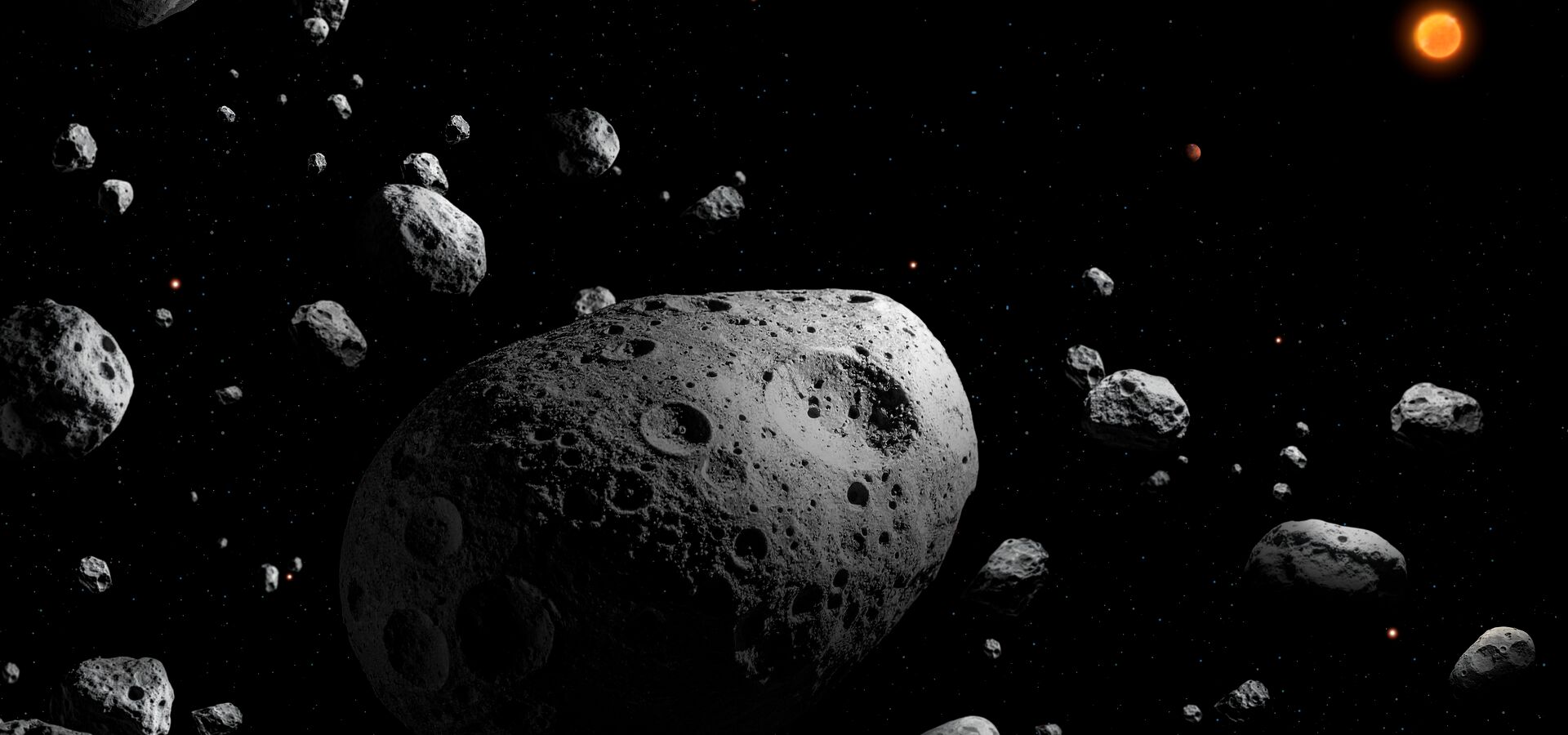
A body in the main asteroid belt, estimated to be 710 metres across, completes a full rotation every 1.88 minutes.
Its surface would sweep around again in just 112.8 seconds.
The asteroid is 2025 MN45, identified in commissioning observations from the NSF-DOE Vera C. Rubin Observatory. Sarah Greenstreet and colleagues reported its lightcurve in The Astrophysical Journal Letters in January 2026. Its period is about 70 times shorter than the 2.2-hour spin barrier beyond which an almost cohesionless asteroid of this size should begin losing material.
This is one study, not settled consensus. The rotation period was recovered repeatedly from the data, but the asteroid’s diameter, internal strength and origin are not direct measurements of a sampled object.
The period came from 517 brightness measurements
Rubin did not make a resolved film of 2025 MN45 turning. At main-belt distances the asteroid appears as an unresolved point, so its rotation is inferred from changes in brightness. An irregular body reflects a different amount of sunlight as each side rotates into view, producing a repeating lightcurve.
The team had 517 observations distributed across 12 days. It recovered the same 0.031-hour period when the measurements were divided by individual night and by colour filter. Two independent analysis methods also produced the same value. Those checks reduce the chance that an unusual observing cadence created a false period.
The Rubin Observatory announcement calls MN45 the fastest-rotating known asteroid with a diameter greater than 500 metres. Greenstreet’s January 2026 conference summary presents the same 1.88-minute period and roughly 710-metre size.
Why the 2.2-hour barrier matters
Many asteroids are rubble piles, collections of rock, dust and empty space assembled after collisions and held together mostly by weak self-gravity. For nearly cohesionless main-belt asteroids larger than about 150 metres, observations show a strong spin boundary near 2.2 hours.
Rotation produces an outward acceleration that grows rapidly as the period shortens. Around the usual barrier, a loose body may change shape, shed surface material or separate. MN45’s reported period is about one-seventieth as long.
Using the nominal diameter and the 112.8-second period, a point on its equator would travel at roughly 71 kilometres per hour. That calculation is illustrative because the real dimensions and shape remain uncertain, but it shows why the standard rubble-pile picture is inadequate.
The paper applied a strength model to ask what would keep the object intact. For a spherical body with an assumed bulk density of 1,700 kilograms per cubic metre, it obtained a required cohesion of roughly 9 megapascals. That is comparable to values associated with strong clay or solid rock, rather than the much weaker bonds expected in ordinary asteroid regolith.
“Solid rock” is a model comparison
The 710-metre diameter is not the result of resolving the asteroid’s edges. The researchers converted absolute brightness into a size by assuming a spherical body with an albedo of 0.15. A darker surface would require a larger object to reflect the same light; a brighter surface could mean a smaller one.
The cohesion estimate likewise depends on size, density, shape and internal arrangement. Change those inputs and the numerical answer changes. No spacecraft has visited 2025 MN45, and the lightcurve cannot distinguish cleanly between one solid monolith, a fractured but coherent rock, or an aggregate whose components have unusually strong bonds.
“Comparable to solid rock” is therefore a description of what the model requires under its stated assumptions. It is not a laboratory test of material collected from the asteroid.
The measurement still rules out a simple explanation. Self-gravity on its own is not sufficient for a 710-metre object rotating at the reported rate.
Rubin found a population, not only one object
MN45 emerged from Rubin First Look observations taken during commissioning. The study began with 2,103 newly discovered asteroids and produced reliable periods for 76. Nineteen rotated faster than the 2.2-hour boundary, while three completed a turn in less than five minutes.
The other ultrafast objects were the roughly 120-metre near-Earth asteroid 2025 MJ71 at 1.92 minutes and the roughly 540-metre main-belt asteroid 2025 MK41 at 3.78 minutes. MN45 combines the shortest period with an estimated diameter comfortably above half a kilometre.
The early sample favours objects with short periods because brief observing runs are much less effective at measuring asteroids that turn over tens or hundreds of hours. Even with that selection effect, the number of fast rotators suggests that strongly cohesive fragments may have been missed by surveys with sparser timing.
For spacecraft, the distinction is practical. Space Travel has followed China’s Tianwen 2 mission to sample the small body Kamo’oalewa. Navigation, anchoring and sample collection all depend on whether a target behaves like intact rock, loose gravel or something between them.
The parent-body explanation remains a hypothesis
Greenstreet and colleagues suggest that the ultrafast rotators may be compact fragments produced when collisions destroyed larger parent asteroids. If a parent body had once been heated enough to differentiate, material from its stronger interior could survive as coherent pieces while weaker debris dispersed.
That is a plausible history, not one contained in the lightcurve itself. The data show periodic brightness changes and colour information. They do not show the collision, identify a parent family or expose the present interior.
Follow-up observations can narrow the possibilities. Thermal measurements would help separate diameter from albedo. Additional lightcurves could constrain shape and spin axis, while spectroscopy could identify surface minerals and test whether the object resembles material expected from a differentiated parent.
For now, the period is the secure result. The solid-rock comparison and destroyed-parent scenario explain how a body of the estimated size might survive it, but both remain interpretations built around an object no spacecraft has yet examined closely.