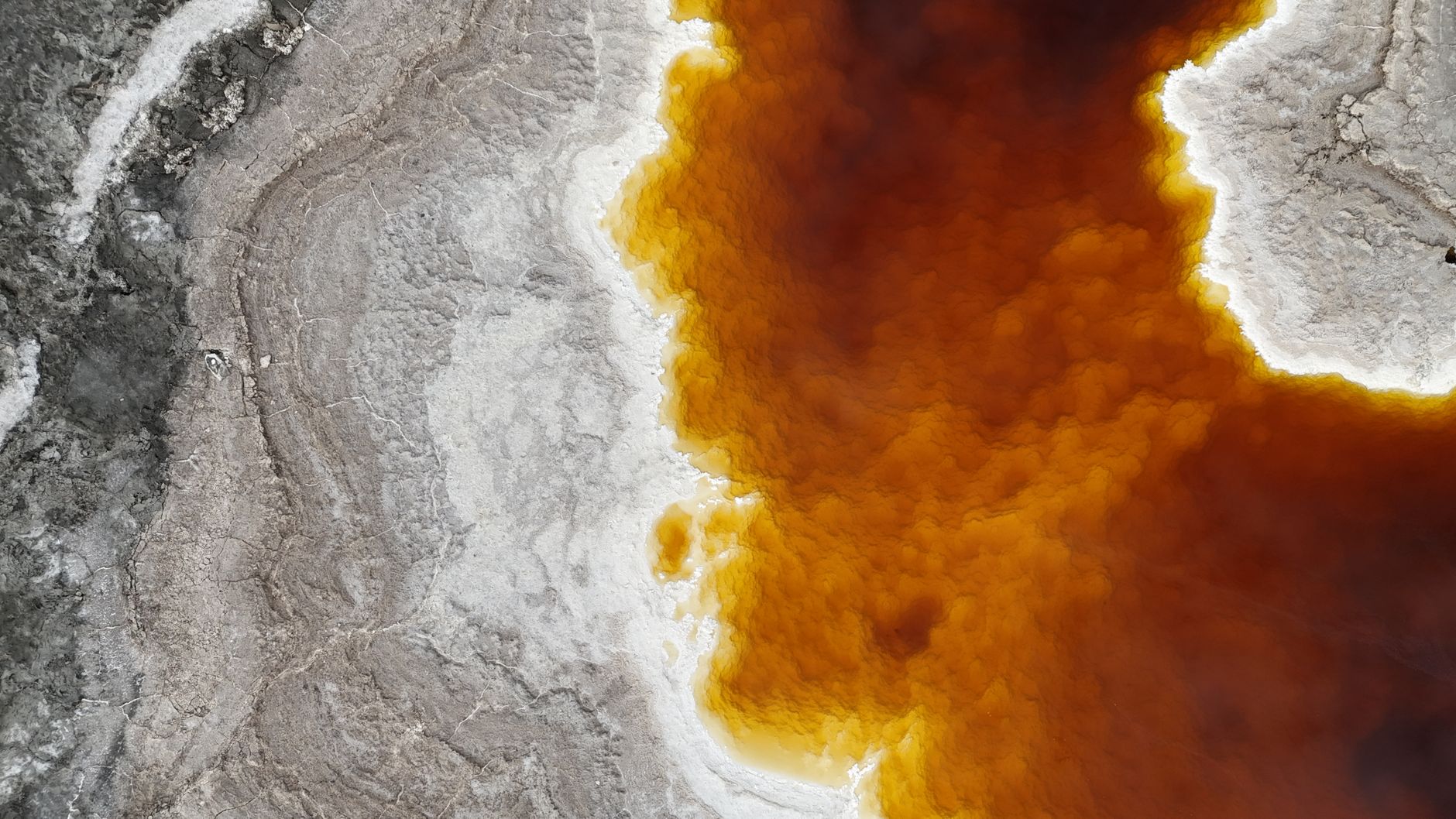
Titan looks familiar at the scale of a weather map. Clouds form in a dense atmosphere, rain falls onto uplands, branching channels carry the runoff downhill, and liquid gathers in lakes and seas. No other world beyond Earth is known to maintain that complete chain of surface liquid and weather.
The resemblance depends on a reversal of materials. At Titan’s surface temperature, close to minus 179 degrees Celsius, water is locked into the crust as a geological solid. Methane and ethane can remain liquid, so hydrocarbons pass through the atmosphere and across a foundation built largely from water ice.
The same sequence operates on Earth, but “exactly” should not be taken to mean the same pace, rainfall pattern or fluid behaviour. Titan runs a genuine hydrologic cycle under very different physical conditions.
The cycle is familiar, while its timing is not
NASA’s Titan overview lists clouds, rain, rivers, lakes and seas of methane and ethane. Surface liquid evaporates, methane condenses into clouds, precipitation falls, runoff enters channels, and the liquid returns to lakes and seas. That sequence, rather than a loose visual similarity, is why Titan is routinely compared with Earth.
A 2018 review in Nature Geoscience by Alexander Hayes, Ralph Lorenz and Jonathan Lunine calls Titan’s methane-based hydrologic cycle an extreme analogue of Earth’s water cycle. The review places its surface pressure at about 1.5 bar and its temperatures between 90 and 95 kelvins. Under those conditions, methane and ethane can condense from a nitrogen-rich atmosphere and flow over the ground.
Several large differences follow. Titan receives roughly one hundredth of the sunlight that reaches Earth, its surface gravity is about one-seventh as strong, and each season lasts more than seven Earth years. Rain can be intense, but observations and models suggest it is sporadic in many regions. A river valley may record an intermittent flood history rather than a stream that runs every day.
Huygens saw what the liquid had done
The atmosphere that makes Titan’s weather possible also hides its surface from ordinary cameras. Cassini therefore used radar and infrared instruments to map the moon through its orange haze. The European Space Agency’s Huygens probe supplied the close view when it descended for two and a half hours and landed on 14 January 2005.
Its images showed bright uplands cut by branching drainage networks, steep-sided channels and darker plains below. In ESA’s reconstruction of the Huygens landing region, ridges between the channels rose 150 to 200 metres, with slopes near 30 degrees. Their form suggested erosion by methane falling as rain. Shorter canyons may have developed where subsurface methane emerged as springs and undermined the base of a hill.
Those scenes need one qualification. Calling water ice Titan’s bedrock does not mean that every metre of ground is clean, exposed ice. The landing plain contained dirty water ice and organic material. Carbon-rich particles produced in the atmosphere settle onto the surface, where they can build dunes, coat cobbles and mix with sediments left by flowing liquid.
Water ice is a structural material there
On Earth, ice often means a seasonal layer that melts, cracks or creeps. On Titan, water ice forms much of the outer crust. It can make hills, channel walls and rounded cobbles, then be fractured, transported and worn down as a geological material.
The headline’s “harder than granite” comparison captures this physical reversal, although it is not a single universal ranking. Hardness, tensile strength and fracture toughness measure different properties, and their values depend on temperature, crystal structure, impurities and the way a load is applied. In a NASA Astrobiology interview, planetary scientist Christopher McKay used the careful formulation: water ice at Titan’s temperature is “as hard as granite” and acts like granite.
That is the useful comparison. Methane rain does not wash over a temporary frozen skin. It meets a durable icy crust, while loose hydrocarbon grains and mixed sediments play some of the roles occupied by sand and soil on Earth.
The lakes are deep, local and chemically mixed
Cassini found most of Titan’s large seas around the north pole. Radar observations from its final Titan flyby in 2017 showed that some smaller northern lakes are more than 100 metres deep and filled mostly with methane. NASA’s report on the measurements says Cassini mapped more than 1.6 million square kilometres of lakes and seas during the mission.
The liquid is not pure methane everywhere. Ethane forms when sunlight and energetic particles break methane apart in the upper atmosphere and the fragments recombine. Methane, ethane and dissolved nitrogen occur in varying proportions, with Cassini measurements indicating differences between the northern lakes and Ontario Lacus in the south.
Nor is Titan covered by a global hydrocarbon ocean. Its seas and lakes are concentrated near the poles, while immense equatorial regions are dry enough to support dunes. Our earlier Space-Travel explainer on Titan’s seasonal lakes examines the climate that sustains this uneven distribution. The moon’s weather is a connected cycle, not a claim that every channel is continuously wet.
Dragonfly will meet the landscape on solid ground
NASA’s Dragonfly rotorcraft is intended to make the next close examination of Titan. The current NASA mission page lists launch no earlier than July 2028 and arrival in late 2034. Its planned 3.3-year mission would use the combination of low gravity and dense air to move among multiple sites, including equatorial dunes and the Selk impact structure.
Dragonfly will not land in a polar sea or follow one of Titan’s long river systems. Its instruments are designed to analyse solid surface samples, atmospheric conditions and organic chemistry. The route should still reveal how sediment is moved and where water ice and carbon-rich material meet.
Cassini mapped the cycle from orbit, and Huygens photographed one small part of its aftermath. Dragonfly is being built to cross the ground that methane weather has shaped.