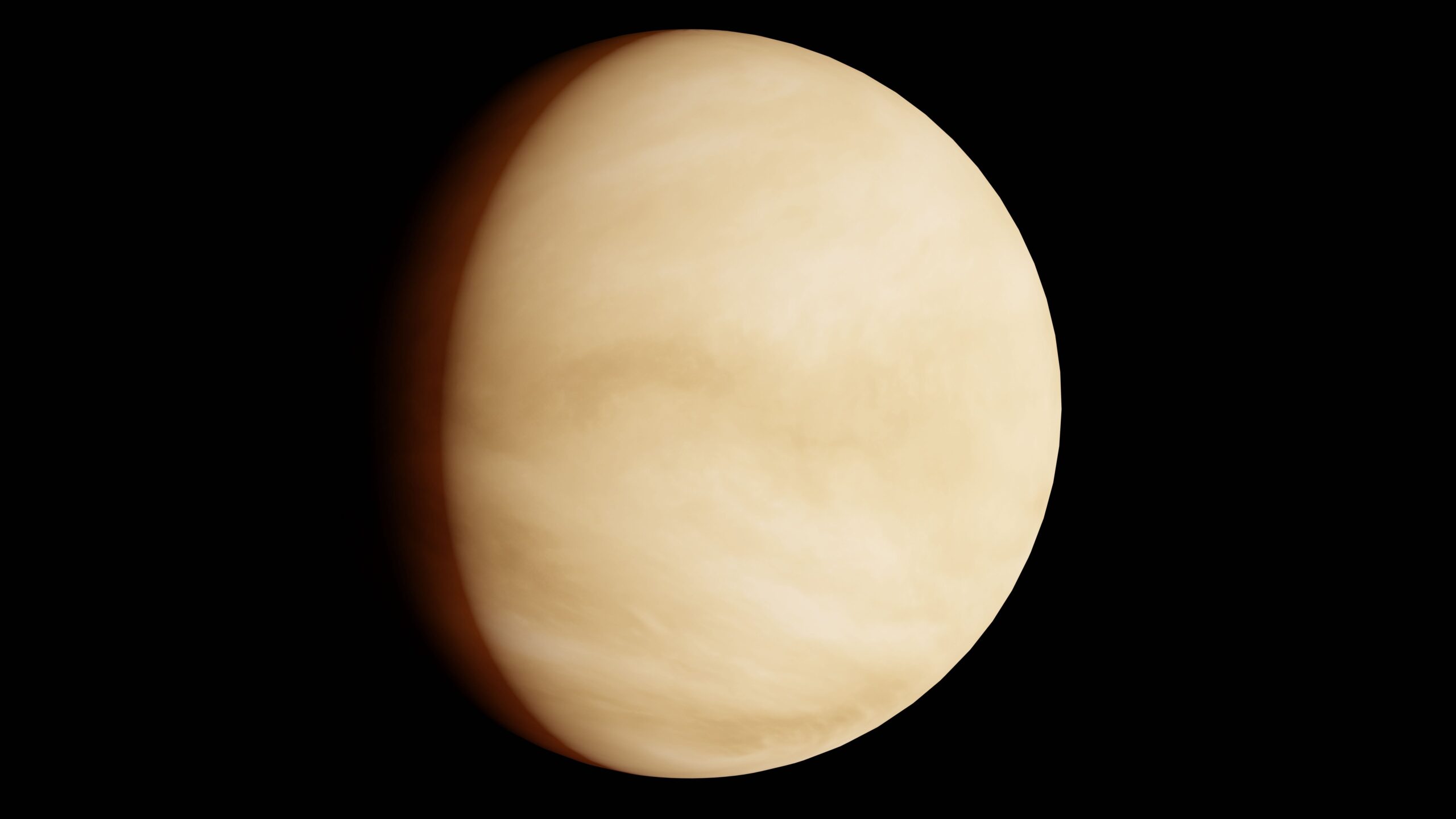
The same atmosphere that turns the surface of Venus into a 467-degree-Celsius pressure cooker may create a far gentler radiation environment 50 kilometres above it. At that height, roughly an Earth atmosphere’s worth of gas remains overhead. A published NASA model estimated that this column would reduce galactic cosmic-ray exposure to levels resembling those within Earth’s atmosphere.
That estimate was calculated, not measured by a dosimeter hanging beneath a Venus balloon. The often-quoted Martian comparison has firmer observational footing: Curiosity’s Radiation Assessment Detector recorded an average of about 0.67 millisieverts per day at Gale Crater over ten months. Comparing the two supports a radiation-specific advantage for a floating Venus habitat, not a verdict that living in Venus’s clouds would be safe overall.
We are writers, not flight surgeons or radiation specialists. What follows is a reading of the mission and radiation research, not medical guidance.
The surface and the cloud layer are different worlds
NASA describes Venus’s average surface temperature as about 467 degrees Celsius, hot enough to melt lead. Its atmospheric pressure is about 93 times Earth’s sea-level pressure. The greenhouse-heated carbon dioxide near the ground is both extremely hot and dense.
The Soviet Venera programme proved that machines could work there briefly. Ten probes reached the surface, according to NASA’s current mission history, but the shortest-lived returned data for 23 minutes and the longest for about two hours. NASA’s work on an Automaton Rover for Extreme Environments gives the more precise range as 23 to 127 minutes before the landers’ electronics failed in the hostile conditions.
Altitude changes the figures quickly. Around 50 kilometres above the surface, NASA gives a temperature range of about 30 to 70 degrees Celsius and pressure comparable to that at Earth’s surface. Gravity remains about 90 per cent of Earth’s. Those three properties explain why engineers have repeatedly examined balloons and airships for Venus.
The surrounding gas is not air. It is still dominated by carbon dioxide, with clouds containing droplets of sulphuric acid. A crew cabin would need to remain sealed, supplied with oxygen and protected against an atmosphere that is chemically hostile even where its pressure is familiar.
Why the atmosphere can act as radiation shielding
Earth’s magnetic field is valuable protection, but the atmosphere is also a massive particle shield. Galactic cosmic rays entering from space collide with molecules above the ground, losing energy and producing secondary particles. The amount and type of material between a person and space therefore matter greatly.
Venus has no internally generated global magnetic field. At an altitude of about 50 kilometres, however, so much of its dense atmosphere is still overhead that the available shielding mass is similar to the entire column above Earth’s surface.
Robert Youngquist and three colleagues quantified that idea in Thick Galactic Cosmic Radiation Shielding Using Atmospheric Data, published in Acta Astronautica in 2014. The team used effective-dose data from aircraft flights at different altitudes to infer the shielding behaviour of Earth’s atmosphere, checked its reconstruction against the original data, then applied the method to other thick shields and planetary atmospheres.
The model treated 50 kilometres above Venus as its reference level, with pressure near one bar and a gas column of roughly one kilogram per square centimetre above it. Its calculated effective-dose curves from 50 to 57 kilometres were very similar to Earth’s. The authors concluded that this part of the atmosphere offered a high degree of protection from galactic cosmic radiation.
This remains a model result. The calculation was not an in-situ dose record from the Venusian clouds, and it did not test a particular cabin, airship envelope or storm shelter. It focused on galactic cosmic rays rather than providing a complete answer for every solar-particle event. The comparison is credible enough to guide mission studies, but not final enough to certify a crewed vehicle.
Curiosity’s 0.67 figure needs its conditions attached
The Mars number came from hardware on the ground. Curiosity’s Radiation Assessment Detector began operating at Gale Crater on 7 August 2012. Don Hassler and colleagues reported its first surface results in a peer-reviewed 2014 paper in Science.
From August 2012 through June 2013, the instrument measured an average dose equivalent of 0.67 millisieverts per day from galactic cosmic rays and energetic particles from the Sun. NASA’s report on the measurements says more than 95 per cent of the total came from cosmic rays and notes that no major solar storm affecting Mars occurred during the ten-month interval.
The figure should not be turned into a fixed planetary constant. Mars’s atmospheric pressure changes with weather and season, the incoming cosmic-ray flux changes with the solar cycle, and sporadic solar events can alter short-term exposure. Gale Crater’s elevation and overhead atmosphere also differ from those of other landing sites.
Even with those limits, Curiosity established the scale of the surface problem. Mars’s thin atmosphere and the solid planet beneath the rover provide some shielding, but far less atmospheric mass stands between a surface crew and incoming high-energy particles than would lie above a platform in Venus’s middle clouds.
This is not a head-to-head safety trial
A floating platform held between about 50 and 57 kilometres on Venus should be substantially better shielded from cosmic radiation than an exposed Martian surface habitat. That is a defensible engineering inference from the two datasets. It is not a simultaneous, instrument-for-instrument comparison.
A mission-level dose assessment would have to include the journeys from Earth, time in orbit, the vehicle’s walls and equipment, secondary particles produced inside shielding, the probability of solar events and any work outside the most protected part of the habitat. Duration matters as much as dose rate. So do the biological assumptions used to convert deposited energy into an estimate of harm.
The larger question is broader than radiation. Space Travel’s coverage of astronaut health research outlines why altered gravity, isolation, limited medical capability and other flight conditions remain part of any long-duration risk assessment. Venus’s gravity is much closer to Earth’s than Mars’s, but no human dataset exists for living in either planetary environment.
Safer from one hazard is not the same as safe.
A breathable cabin could lift itself, in principle
Carbon dioxide is denser than the nitrogen-oxygen mixture people breathe. At the pressure around 50 kilometres, ordinary breathable air would therefore act as a lifting gas inside a sufficiently large envelope. Unlike hydrogen or helium in Earth’s atmosphere, it would not need to be kept separate from the occupied volume solely to provide buoyancy.
NASA Langley’s High Altitude Venus Operational Concept, known as HAVOC, examined a two-person airship operating at about 50 kilometres for 30 days. It was an internal architecture study, not an approved mission. Its authors identified aerocapture, atmospheric entry, airship deployment and inflation, and protection of the structure and solar arrays from sulphuric acid as central technical problems.
Deployment is especially unforgiving. A large folded envelope would have to enter Venus’s atmosphere inside a protective aeroshell, slow down, unfold and inflate while the vehicle was still descending. A failure that would leave a ground habitat sitting still could send an airship into hotter, denser layers.
Long-term flight would add its own demands. The habitat would drift with fast-moving clouds, control its altitude, generate and store power, communicate through the atmosphere, resist acid exposure and maintain envelope integrity without an accessible runway or repair depot. Any ascent vehicle would then have to launch the crew from a moving aerial platform.
The next evidence should come from the clouds
The most useful near-term tests do not require a crew. Long-duration robotic balloons could expose candidate coatings, joints, solar cells and instruments to the real cloud environment. They could also measure radiation at several altitudes across changing solar conditions, directly testing the atmospheric model used in the Earth comparison.
A credible crewed study would then need a full failure analysis for loss of buoyancy, envelope damage, power interruption, altitude-control faults and delayed communications. It would need to show that the vehicle could deploy reliably before anyone was committed to it.
Any judgement about individual dose limits and medical risk belongs with mission radiation specialists and flight surgeons using the final trajectory, vehicle and crew profile. Neither an atmospheric model nor a rover average can set those limits alone.
Venus’s middle atmosphere may remove much of the radiation penalty faced on Mars, but a human platform there would remain an aircraft that could never safely land.