
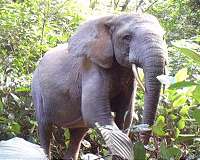
Thai police are looking for a pineapple farm worker suspected of setting up an electric fence that has killed two wild elephants in the past month, authorities said Tuesday.
Cops are searching for the man after the second elephant was found dead over the weekend, lying on its side outside a pineapple farm in Chonburi province that edges up against a national park.
The four-tonne animal lay around 100 metres away from where a female elephant fell dead last month.
A plantation worker, Samin Jansamut, was charged after the first elephant death with poaching but had since been released on bail, police said.
"The suspect used live wire to make a fence and then connected it to electricity…at night," said Phadet Laithong, a regional park official.
"There were signs of burning on (the second elephant's) trunk and his side, so it's likely that he was electrocuted," he added.
Police are now looking for him again following the second elephant death.
Conservationists estimate Thailand is home to more than 3,000 wild elephants.
But deforestation and habitat loss in recent decades have brought herds in closer contact with villages, igniting conflicts — and sometimes human deaths — when the animals trample on plantations or steal farmers' produce.
Soraida Salwala, the founder of the NGO 'Friends of the Asian Elephant', said she was "devastated" by the Chonburi elephant's apparent electrocution.
"Electrocution should not be carried out against any animals," she told AFP.
"I have called for an emergency fund to compensate to farmers in case their produce is eaten by elephants," she added.
Thailand also hosts Asia's biggest elephant tourism industry, with some 2,000 pachyderms employed to take tourists on rides or perform in circuses.
Animal rights groups have long criticised the lucrative industry as inhumane, with many elephants relegated to lives on the end of a chain.
Nearly extinct Javan green magpies thrive at Prague zoo
Prague (AFP) April 17, 2018 –
Prague zoo said Tuesday that its small flock of critically endangered Javan green magpies was growing, thanks in part to a special new feeding technique using a puppet.
The zoo currently has six Javan green magpies, including two chicks, one of which is being fed with the help of tweezers and a puppet resembling the adult of the striking species, known for its blue-green feathers and orange-red beak.
"We found one broken egg under a nesting pair so we immediately took the other one away," bird curator Antonin Vaidl told AFP, adding that the chick was hatched in an incubator in March.
"Then we started using this puppet so that the chick would not be imprinted on a human and could reproduce within its species," Vaidl told AFP, referring to the process by which a bird learns to recognise its species.
Javan green magpies are among the "rarest bird species on the planet today," Vaidl said, adding that the total global population in captivity and the wild is around 100.
"Pessimistic estimates indicate that there are fewer than 50 birds in Indonesia, its country of origin," he added.
A 2016 study by the wildlife trade monitoring network TRAFFIC warned that 13 species of Indonesian birds, including the Javan green magpie and the country's symbolic Javan hawk-eagle, were at serious risk of extinction mainly due to the pet trade.
Prague zoo got its first pair of Javan green magpies in 2015 from the Chester zoo in northwestern England near Liverpool.
The pair was the first to successfully breed in captivity in Europe, producing three offspring in April 2016.
"It was the first-ever evidence that Javan green magpies can have more than two offspring at a go. People always believed two was the maximum," Vaidl said.
He said that so far the zoo had successfully hatched a total of five chicks.
