
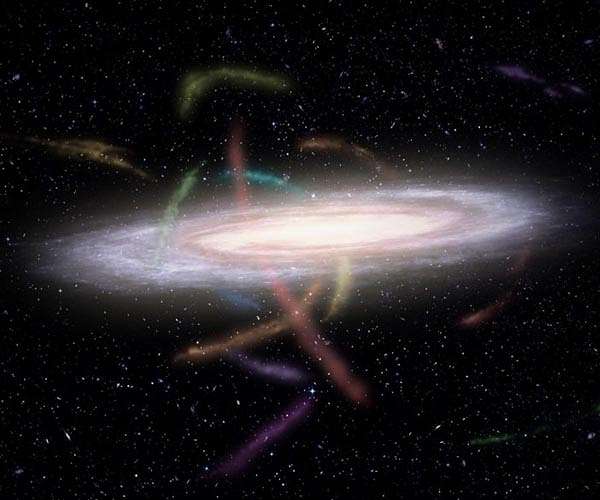
Astronomers are one step closer to learning the properties of dark matter enveloping our Milky Way galaxy, thanks to a new map of twelve streams of stars orbiting within our Galactic halo.
Understanding these stellar streams is very important for astronomers. As well as revealing the dark matter that holds the stars in their orbits, they also tell us about the formation history of the Milky Way, revealing that the Milky Way has steadily grown over billions of years by shredding and consuming smaller stellar systems.
"We are seeing these streams being disrupted by the Milky Way's gravitational pull, and eventually becoming part of the Milky Way. This study gives us a snapshot of the Milky Way's feeding habits, such as what kinds of smaller stellar systems it 'eats'. As our Galaxy is getting older, it is getting fatter." said University of Toronto's Ting Li, the lead author of the paper.
Li and her international team of collaborators-including Lowell Observatory's Kyler Kuehn-initiated a dedicated program-the Southern Stellar Stream Spectroscopic Survey (S5)-to measure the properties of stellar streams: the shredded remains of neighboring small galaxies and star clusters that are being torn apart by our own Milky Way.
Li and her team are the first group of scientists to study such a rich collection of stellar streams, measuring the speeds of stars using the Anglo-Australian Telescope (AAT), a 4-meter optical telescope in Australia. Li and her team used the Doppler shift of light, used by the police radar guns to capture speeding drivers, to find out how fast individual stars are moving.
Unlike previous studies that have focused on one stream at a time, "S5 is dedicated to measuring as many streams as possible, which we can do very efficiently with the unique capabilities of the AAT", comments co-author Daniel Zucker of Macquarie University.
The properties of stellar streams reveal the presence of the invisible dark matter of the Milky Way. "Think of a Christmas tree", says co-author Geraint F. Lewis of the University of Sydney. "On a dark night, we see the Christmas lights, but not the tree they are wrapped around. But the shape of the lights reveals the shape of the tree," he said. "It is the same with stellar streams – their orbits reveal the dark matter."
A crucial ingredient for the success of S5 were observations from the European Gaia space mission. "Gaia provided us with exquisite measurements of positions and motions of stars, essential for identifying members of the stellar streams" says co-author Sergey Koposov of the University of Edinburgh.
As well as measuring their speeds, the astronomers can use these observations to work out the chemical compositions of the stars, telling us where they were born. "Stellar streams can come either from disrupting galaxies or star clusters," says co-author Alex Ji of the University of Chicago. "These two types of streams provide different insights into the nature of dark matter."
According to Li, these new observations are essential for determining how our Milky Way arose from the featureless universe after the Big Bang. "For me, this is one of the most intriguing questions, a question about our ultimate origins", Li said. "It is the reason why we founded S5 and built an international collaboration to address this".
The S5 collaboration has not only built on the work of earlier scientists, but branched out into entirely new science. Kuehn says, "Understanding the characteristics of a dozen separate stellar streams is a significant accomplishment, and there will be plenty more results to come from S5. We're learning a lot about these streams from our observations, and in the not-too-distant future, we expect to use them to measure important properties of the Milky Way itself-including its total mass and the way that dark matter is spread out through our Galaxy."
Li adds, "We are trail-blazers and pathfinders on this journey. It is going to be very exciting!"
