
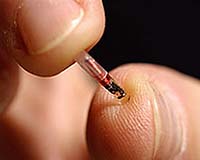
What if your boss asked you to have a chip implanted in your arm? Would you do it? What if it meant getting a higher salary? Radio frequency identification (RFID) tags, small circuits consisting of a microchip and an antenna that generate a radio signal when triggered by a reading device, are implanted in millions of pets and livestock to keep track of them and return them to their owners if they are lost.
In the last few years people have begun to have tags planted in themselves–a move that could have serious repercussions for our privacy and freedom, according to Kenneth R. Foster and Jan Jaeger, University of Pennsylvania professors and authors of an article in the March issue of IEEE Spectrum.
Indeed, society has yet to answer such basic questions as whether an implanted tag is the property of the person it's implanted in or the company that issued the tag. When you leave a job, you typically turn in your keys, Foster and Jaeger point out. Would you have to have an implant surgically removed with each job change?
Although mandating that everyone be chipped seems far from likely, Jaeger and Foster are concerned that supposedly voluntary implantation would be anything but.
Responding to a proposal to chip guest workers entering the United States for employment, they write: "Guest workers might ostensibly consent to having chips implanted. But would chipping them be truly voluntary?
Such 'voluntary' actions may determine a person's ability to earn a living, and the worker might not view the implantation as something he or she could refuse. What person facing poverty at home and given the prospect of a job in a different country would be in a position to argue?"
With thousands of people already implanted, it's past time to answer these thorny questions.
Hands On
Amal Graafstra doesn't have a chip on his shoulder. But he does have one in his hand. Two, in fact.
Graafstra, a computer technician, decided one day in 2005 that he was tired of carrying his keys. He disliked losing keys or leaving them behind, and he surmised that there must be a simpler way.
The technology of radio frequency identification, or RFID, caught his eye, and it wasn't long before he found himself sitting in a doctor's office, his hand numbed, as a cosmetic surgeon carefully slipped a tag underneath his skin.
Radio frequency identification technology can transmit identifying information about a person or object wirelessly, using radio waves. These tiny tags, which consist of a chip and an antenna, have been used for more than a decade in applications like managing inventory–but only recently have they started catching on with humans.
Graafstra is one of the first to use RFID to replace the locks in his life, and he writes in IEEE Spectrum about how he rigged his life to be compatible with his new chip.
No longer does he carry keys to his apartment, car or motorcycle. Instead, he holds his hand up to an RFID reader, which is a device that can communicate with the chip, and a fraction of a second later he's on his way.
The method seemed to work so well that his girlfriend also agreed to get implants–RFID ones, not the other controversial kind–so they could share cars and homes and computers with keyless, passwordless abandon.
But is it safe? Graafstra writes about experiments he and others have conducted to test the security of RFID lock systems. The future is murky, and he describes the reasoning behind his decision to implant a second, more sophisticated, chip, to feel safer about the technology inside his body.
