
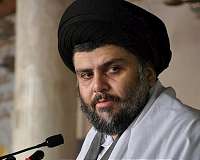
Thousands of supporters of Iraqi cleric Moqtada Sadr protested on Friday to support the sanctity of "religious symbols," a day after a march saw unprecedented public criticism of their leader.
"We are one tribe and our leader is Moqtada Sadr!" chanted a crowd of men on Friday in Tahrir Square, the main gathering place in Iraq's capital for rival anti-government rallies.
Sadr, who has a cult-like following across Iraq, first backed the popular protests when they erupted in October but has since split with them over the appointment of a new prime minister.
The cleric backs Mohammad Allawi, a premier-designate rejected by most demonstrators as too close to the ruling class they have railed against for months.
Over the last two weeks, Sadr has sought to clamp down on the main movement and his followers have attacked rival demonstrators.
In another twist, the cleric published a series of guiding principles for protesters this week, including separation of the sexes and banning drugs or alcohol.
"We will not stay with arms crossed, silent in the face of insults against religion, morality and country," Sadr said.
Many have long been afraid to criticism the militiaman-turned-politician because of his influence, but his comments on Twitter were met with outrage and mockery.
On Friday though, Sadrists held counter-protests in Baghdad, the southern port city of Basra and the shrine city of Najaf, rejecting criticism of their leader.
"We reject agitators who sneak in among the protesters, shattering the movement's peaceful nature and insulting prophets and religious symbols," one Sadrist told AFP.
There were no clashes between the Sadr supporters and the anti-government demonstrators, but previous clashes between the two have left eight activists dead.
Around 550 people have been killed since the rallies erupted four months ago and another 30,000 wounded.
Incoming premier Allawi has until March 2 to form his new cabinet, which would need a vote of confidence from Iraq's divided parliament.
His government is expected to steer Iraq into early legislative elections, a key demand of protesters.
Iraq protesters rally for one of their own to become PM
Karbala, Iraq (AFP) Feb 16, 2020 –
Hundreds of Iraqis rallied Sunday to support a protest leader they want as prime minister instead of current premier-designate Mohammad Allawi, who they see as too close to the ruling class.
Appointed on February 1, Allawi has pledged to announce his cabinet lineup within the week even as he faces ongoing protests against his nomination — and a new contender.
In the shrine city of Karbala, dozens of students took to the streets carrying photos of Alaa al-Rikaby, a pharmacist who has emerged as a prominent activist in the protest hotspot of Nasiriyah, further south.
"We're here to show our support for Alaa al-Rikaby, the candidate of the people!" said Seif al-Hasnawy, a 20-year-old student.
Rikaby, who has a round face and closely-trimmed beard, began demonstrating in early October alongside others fed up with rampant corruption, lack of jobs and poor public services.
He has since risen to local fame with a series of videos posted on Twitter to his tens of thousands of followers, discussing politics and a path forward for the otherwise leaderless anti-government movement.
In one video last week, he asked protesters who gather at squares across the country to show whether they would back him for the post of prime minister, in a novel approach for a political nomination in Iraq.
"If the people decide so, I'd accept," he said in his latest video on Thursday.
"This post has no value as such for me. I don't see it as a prize, but rather as a huge responsibility," said Rikaby, who has a tent pitched in central Nasiriyah targeted in a recent stun grenade attack.
In Karbala, university student Hassan Qazwini told AFP: "We protesters have numerous demands, and one of them is an independent prime minister without ties to parties — like Alaa al-Rikaby."
Before Rikaby, Faeq al-Sheikh Ali, a liberal critic of the ruling class, also declared himself a candidate but has not received mass public or political backing.
Allawi was nominated on February 1 as a consensus candidate among Iraq's fractured political parties but has only been publicly endorsed by cleric Moqtada Sadr, who has a cult-like following across the country.
Since the 2003 US-led invasion that toppled dictator Saddam Hussein, cabinets have been formed through a sectarian power-sharing system, leading to widespread horsetrading among various sects and parties.
Iraq's Shiite, Sunni and Kurdish factions are likely to hold on tight to their shares of posts in the outgoing cabinet and aim to carry them over into the next lineup.
Allawi has until March 2 to form a government and Iraqi officials have quietly expressed scepticism that he would be able to complete it in time.
But in a surprising tweet on Saturday, Allawi said he would be ready to submit a cabinet to parliament within the week for a vote of confidence.
Parliament is officially in recess until mid-March and the house speaker, Mohammed Halbusi, has not yet scheduled an extraordinary session.
