
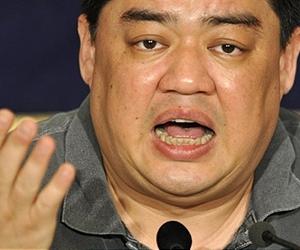
Two former leaders of the 1989 Tiananmen protests who were refused entry into Hong Kong this week said Thursday their exclusion exposed Beijing's strengthening grip on the autonomous territory.
Wang Dan and Wu'er Kaixi, who live in exile in Taiwan, have been refused entry to the former British colony, where they planned to attend a memorial service for democracy icon Szeto Wah this weekend.
"The Beijing authorities should provide an explanation as to why they did this, which is a humiliation to the deceased and to Hong Kong's taxpayers," Wu'er told reporters in Taiwan.
The Hong Kong government's move also sparked concerns from Amnesty International.
"Amnesty International Hong Kong calls on the Hong Kong authorities to explain why they would not allow Wang Dan to enter Hong Kong and to ensure that all visitors intending to come to Hong Kong are not subject to similar treatment," the group said in a statement Thursday.
It pointed out that Hong Kong had ratified the International Covenant on Civil and Political Rights, which includes the right to freedom of movement.
Hong Kong Chief Executive Donald Tsang and security head Ambrose Lee declined to comment on the incident.
The two former student leaders said their exclusion from Hong Kong showed Beijing had tightened its grip on the officially autonomous territory and the "one country, two systems" concept under which Beijing governs Hong Kong and the former Portuguese colony of Macau was dead.
Beijing regards Taiwan as its territory and has proposed a similar "one country, two systems" arrangement — an offer flatly rejected by Taipei.
As Taipei's ties with Beijing improve under the China-friendly Kuomintang government, "Taiwan should place human rights and democracy on its agenda while holding trade talks, and political talks," Wang said.
Wu'er — who was allowed to visit Hong Kong in 2004 — said "Taiwan should have underscored human rights and democracy. This is the card Taiwan should have played in talks with China.
"But instead, it seems that all the politicians at the Kuomintang party have been trying to do is something to please Beijing."
Many people had been dazzled by "the rise of China" but the Kuomintang government should take note of "the part of Chinese communists which remains unchanged after decades," Wu'er added, referring to their tight grip on power.
Szeto Wah died of cancer at the age of 79 earlier this month, and his memorial service in Hong Kong is expected to draw thousands of mourners.
The one-time Hong Kong legislator helped many dissidents flee China after the bloody crackdown on protests around Tiananmen Square, which saw hundreds, if not thousands, of people killed.
Taiwan has governed itself for more than six decades, since the Kuomintang fled there in 1949 at the end of their civil war against the Communists.
Ties between Taipei and Beijing have improved markedly since the Kuomintang's Ma Ying-jeou came to power in 2008 on promises of beefing up trade and allowing more Chinese tourists to visit Taiwan.
Share This Article With Planet Earth
