
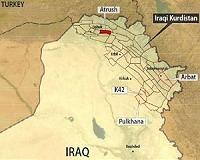
The U.N. special envoy to Iraqi said Tuesday an agreement between the Kurdish and federal government is a turning point for the country's oil sector.
The Iraqi federal government confirmed a deal with the semiautonomous Kurdistan Regional Government ends a long impasse over oil exports.
"I look forward for the implementation of the agreement as swiftly as possible, including oil exports from the Kurdish region and Kirkuk, as well as the disbursement of the KRG budget from the Iraqi general budget," envoy Nickolay Mladenov said in a statement.
Word of a breakthrough surfaced last month when both sides agreed to an interim solution to an oil row brewing at least since the implementation of an Iraqi constitution in 2006.
That document says the federal State Oil Marketing Organization has exclusive control over petroleum exports, with the KRG taking 17 percent of all oil revenues.
There were disagreements, however, over what level of control KRG has over contracts and exploitation of oil reserves in its northern territory.
Under the terms of the new agreement, around 250,000 barrels of oil per day are permissible for exports, while another 300,000 bpd will come from the disputed northern province of Kirkuk. Both sides will export their oil through SOMO, while the KRG keeps its 17 percent of national oil revenue.
Mladenov said the deal came as a result of tough negotiations between Kurdish Prime Minister Nechirvan Barzani and his Iraqi counterpart, Haider al-Abadi, who was able to accomplish something his predecessor, Nouri al-Maliki, could not.
"Only through direct and frank dialogue can agreements be reached that serve the interests of Iraq and the Iraqi people," he said.
The Organization of Petroleum Exporting Countries said in its November market report Iraqi oil production was holding steady at around 3.2 million bpd
Gulf Keystone Petroleum, which has headquarters in London, said it's on track to pull 40,000 barrels of oil per day from its Shaikan development in the Kurdish north by year's end. The company announced Monday it was now ready to start receiving steady payments for oil exported from the Kurdish north.
"It represents a major step forward for us and we are grateful to our partners in the KRG, who we resolutely stand beside," Gulf Keystone Chief Executive Officer John Gerstenlauer said in a statement.
His company has been exporting oil from the Kurdish north for about a year. Unilateral Kurdish oil exports have been a source of contention between KRG and Baghdad, with both sides making their case to the U.S. courts.
More than 1 million barrels of Kurdish crude oil were parked off the coast of Texas during the summer. While the U.S. government said there were no obstacles to oil sales from "any part of Iraq," Washington had sided with Baghdad in its claims to export jurisdiction.
It's unclear how the deal plays out for similar disputes over maritime shipments of Kurdish oil, which emanate from the Turkish port city of Ceyhan.
The Kurdish prime minister, in signing the agreement, said the Iraqi oil belongs to all Iraqis.
