
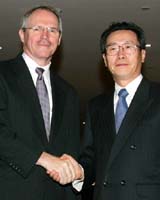
US envoy Christopher Hill said Sunday he hoped six-party talks on ending North Korea's nuclear weapons program would resume "very soon" as he arrived here for consultations with his Chinese counterpart. Hill was to meet Chinese Vice Foreign Minister Wu Dawei at the end of a regional tour to brief his Asian negotiating partners on his rare one-on-one talks with North Korea's Kim Kye-Gwan in Berlin last week.
"I will ask him (Wu) about his thoughts on when they could schedule the next round of six-party talks because we would like to do that as soon as that is convenient for the Chinese government," Hill told journalists upon his arrival.
"We would like them very soon, but it will be up to him … and of course he has to talk to the other participants."
Hill is scheduled to return to Washington early Monday.
In Japan on Saturday, Hill described the talks with Kim as "substantial" but declined to confirm a report that six-way negotiations would resume February 6.
"They were very concrete. We discussed some of the specific issues that we would need to negotiate in the six-party talks but in no way are those meetings in Berlin a substitute," Hill said.
The talks — bringing together North and South Korea, the United States, China, Russia and Japan — made little tangible progress in the last round in Beijing in December.
International concern has intensified since North Korea, one of the most isolated and impoverished countries in the world, tested a nuclear weapon in October.
The test led to UN sanctions and even condemnation from China, Pyongyang's lone major ally, but the regime has repeatedly insisted that the United States must lift financial sanctions against it for talks to proceed.
Hill voiced hope on Saturday that "the next session, whether it's a late January or an early February session, does achieve more progress."
He said that would mean implementing a September 2005 statement under which North Korea agreed in general terms to give up its nuclear program in exchange for aid and security guarantees.
North Korea walked out of the talks two months later to protest the US sanctions. It returned to the table only last month after testing its first nuclear bomb on October 9.
The last session saw no tangible progress, with an emboldened North Korea sticking to its demands that the United States stop blacklisting a Macau bank accused of laundering money on behalf of the impoverished state.
Hill said the US Treasury Department would resume talks in the coming two weeks with Pyongyang about Macau's Banco Delta Asia, which holds 24 million dollars in frozen North Korean funds.
He also said that China, the host of the full six-nation talks, was sounding out capitals for the date of the next session.
Hill played down North Korea's assertion that the Berlin negotiations had yielded "a certain agreement."
"I'm glad they have a positive assessment because we believe our discussions were very useful," Hill told reporters after talks at the Japanese foreign ministry on Saturday.
The US envoy visited Seoul and Tokyo before heading to Beijing.
Source: Agence France-Presse
