
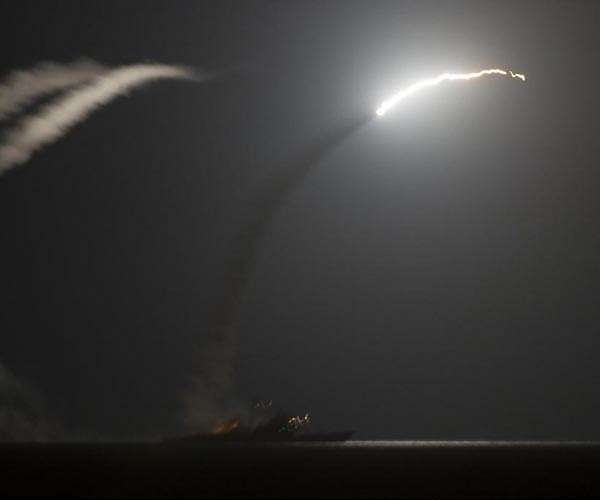
The United States launched airstrikes in Syria and Iraq Friday in retaliation for the killing of three U.S. soldiers in Jordan last Sunday.
U.S. Central Command at 4:28 p.m. EST said American forces struck more than 85 targets in Iraq and Syria "against Iran's Islamic Revolutionary Guards Corps (IRGC) Quds Force and affiliated militia groups," ABC news reported.
In a statement from the White House, President Joe Biden said the U.S. attacks on militia sites "will continue at times and places of our choosing."
"This past Sunday, three American soldiers were killed in Jordan by a drone launched by militant groups backed by Iran's Islamic Revolutionary Guards Corps," Biden said. "Earlier today, I attended the dignified return of these brave Americans at Dover Airforce Base, and I have spoken with each of their families.
"This afternoon, at my direction, U.S. military forces struck targets at facilities in Iraq and Syria that the IRGC and affiliated militia use to attack U.S. forces. Our response began today. It will continue at times and places of our choosing.
"The United States does not seek conflict in the Middle East or anywhere else in the world. But let all those who might seek to do us harm know this: If you harm an American, we will respond," Biden said.
More than 40 other U.S. troops were wounded in the drone attack on Tower 22 base in Jordan near the border with Iraq and Syria. Officials blame Iran-backed militants for the strike, while Iran has denied any connection.
National Security Council spokesman John Kirby was reported by NBC as telling reporters that U.S. forces struck a total of seven facilities used by militias backed by Iran.
"Three of the facilities are in Iraq. Four of them are in Syria," Kirby said.
In a post on X, the U.S. Central Command said the airstrikes employed more than 125 precision munitions.
"The facilities that were struck included command and control operations centers, intelligence centers, rockets, and missiles, and unmanned aerial vehicle storages, and logistics and munition supply chain facilities of militia groups and their IRGC sponsors who facilitated attacks against U.S. and Coalition forces," the social-media post stated.
The counteroffensive comes after Biden earlier in the day attended the dignified transfer of the three soldiers killed in the Jordan attack. The president previously vowed the United States would respond to the attack but did not give details.
Defense Secretary Lloyd Austin, who also attended the return of the slain soldiers with the president, said Thursday that the United States would give a "multi-tiered" response.
"We have the ability to respond a number of times, depending on what the situation is," Austin said at a press conference at the Pentagon. "They have a lot of capability. I have a lot more."
National Security Council spokesperson John Kirby said Wednesday he believes "the attack in Jordan was planned, resourced and facilitated by an Umbrella group called the Islamic Resistance in Iraq."
Which armed groups in Iraq and Syria are likely in US crosshairs?
Baghdad (AFP) Feb 2, 2024 –
Washington has warned of "multiple actions" against Iran-backed groups in Iraq and Syria in retaliation for a drone strike in Jordan that killed three US troops.
AFP looks at the groups and targets potentially in Washington's crosshairs after the first fatal attack on US forces in the region since the Israel-Hamas war broke out in October.
Islamic Resistance in Iraq
The White House has blamed the Islamic Resistance in Iraq for Sunday's attack on Tower 22, a remote frontier base in Jordan's northeast near the border with Syria.
The Islamic Resistance in Iraq, a loose alliance of pro-Iran fighters, opposes US support for Israel in the Gaza conflict and calls for the withdrawal of US troops stationed in Iraq as part of an international coalition fighting remnants of the Islamic State jihadist group.
The Pentagon has said the unclaimed Jordan attack had the "footprints" of Kataeb Hezbollah, or the Hezbollah Brigades, an Iran-backed Iraqi militant group and a key member of the Islamic Resistance in Iraq.
Two other groups have publicly announced their adherence to the alliance: the pro-Iran Al-Nujaba movement and the Kataeb Sayyid al-Shuhada.
Classified as "terrorists" by Washington, the groups are also affiliated with Hashed al-Shaabi, mainly pro-Iran former paramilitaries now integrated into Iraq's armed forces.
The Islamic Resistance in Iraq has claimed dozens of drone and rocket attacks against US troops deployed in Iraq and Syria as part of the international anti-jihadist coalition.
US and coalition troops in the region have been attacked at least 165 times since mid-October, according to a US defence official.
Potential targets
In recent weeks, Washington has targeted Kataeb Hezbollah and the Al-Nujaba movement, including with a strike in the Iraqi capital that infuriated Baghdad.
Strikes have targeted the Jurf al-Sakhr district, a militarised zone around 60 kilometres (more than 35 miles) south of Baghdad largely controlled by pro-Iran factions.
Al-Qaim, near the border with Syria's eastern Deir Ezzor province in an area where Iran-backed groups hold sway, has also come under US attack.
Riad Kahwaji, head of the Institute for Near East and Gulf Military Analysis, said the United States had "plenty of options" for strikes in Iraq, adding that Washington would likely target weapons depots and drone launch sites.
In Syria, he said he expected Washington to target Iraqi border areas where groups from the Islamic Resistance have their "biggest concentration".
Mayadeen and Albu Kamal in Deir Ezzor province "are the biggest two bases which I expect to see hit," he added.
Rami Abdel Rahman, head of the Syrian Observatory for Human Rights, a war monitor, also said Iraqi armed groups' positions in Deir Ezzor, including Mayadeen and Albu Kamal, could be targets.
He also pointed to the Palmyra desert region in central Syria "where there are airports for launching drones".
Pro-Iran fighters have evacuated bases and positions in eastern Syria, while "many officers from Iran's Revolutionary Guards have withdrawn to Damascus", added Abdel Rahman, whose organisation has a wide network of sources inside Syria.
Limiting the damage?
In Iraq, an official from a pro-Iran faction, requesting anonymity for security reasons, told AFP in response to "American threats", armed groups had "moved some equipment and left some military bases for other positions".
Another factional official, also requesting anonymity, said "some commanders on the ground" had gone to Iran, while others were hunkering down in "safe positions".
Although Washington has promised a response, officials have said the United States does not want war with Iran, where officials have sought to distance themselves from the Jordan attack.
This week, Kataeb Hezbollah said it would halt its attacks on US troops and urged its fighters to "use passive defence (temporarily), if any hostile American action occurs towards them."
Apparently seeking to clear Iran of responsibility, the group said Tehran often objected to "the pressure and escalation against the American occupation forces in Iraq and Syria".
On Thursday, Barbara Leaf, US assistant secretary for Near Eastern affairs, said the attacks by Iran-backed groups were "an assault on the sovereignty of Iraq", its arms control and its foreign and national security policy.
"We'd like to see more action" by the Iraqi state to rein the groups in and hold those responsible to account, she added.
But on Friday, the Al-Nujaba movement said it intended to press on with attacks on US troops in the Middle East, warning that "any (US) strike will result in an appropriate response."
burs/dv
