
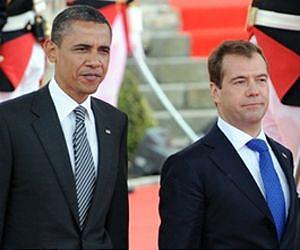
Despite diplomatic payoffs and a "free-flowing" dialogue with the Kremlin, the legacy of Cold War history and suspicion sometimes still challenges the "reset" US-Russia relationship.
Presidents Barack Obama and Dmitry Medvedev met Thursday on the sides of the G8 economic summit in France, and there were the usual professions of friendship, cooperation and praise for how far they have come in two years.
US officials say the reset has yielded a new nuclear pact, several key Russian diplomatic interventions, and regular progress towards navigating the political thicket thrown up against the Americans' Europe-based defense system.
They cite the fact Russia did not block a UN resolution paving the way for NATO action in Libya and brandished 12 communiques on joint initiatives issued on matters as diverse as business and anti-terror cooperation on Thursday.
They say Obama and Medvedev have "free-flowing" chats and said that their stern expressions on display before reporters Thursday were the result of translation issues and a muggy room, rather than a testy meeting.
But time and again, Russia prickliness over the missile defense scheme emerges, despite Obama's decision to scale down a George W. Bush-era system, reasoning he could still meet the threat from Iran's missiles.
And there have been signs that the Russian side is perhaps less enamoured with its ties with Washington — and uncertainty about how the "reset" might be impacted if Vladimir Putin recaptures the presidency next year.
Asked whether there was still a lack of trust at some level of the US-Russia relationship, Michael McFaul, senior director for Russia on the National Security Council answered simply: "Yes."
But McFaul said the pace of talks on the missile defense system and what he said was a "bold" visit last year to a NATO summit — an organization set up to resist the Soviet Union — by Medvedev were proof of the reset's worth.
Another key NSC official Ben Rhodes said the very act of tackling big issues helped build layers of trust through the US-Russia relationship — with the potential to deliver a lasting legacy.
"It's the issue of trust and that trust builds up through these types of discussions," Rhodes said.
"The United States and Russia see it in their common interests and have made again, commitments across our governments to work together in a sense of cooperation in ways that will endure for years to come," Rhodes said.
Signs of sensitivity over the missile defense programme were revealed again Thursday when Medvedev commented that the ultimate solution over the system may not be ultimately put to rest until he and Obama are gone from the political scene.
The Russian leader said the missile defence issue "will finally be solved in the future, like for example in the year 2020" by future politicians, and that he and Obama can only lay the groundwork for their successors.
McFaul played down concerns about the 2020 timeline, saying that it was based on Russian concerns that phase four of the system could threaten "strategic stability."
"We have no intention of doing that," said McFaul.
Obama, recognizing the tricky diplomatic territory, promised to work with Medvedev "so we can find an approach and configuration that is consistent with the security needs of both countries."
But Russia has frequently complained that its issues over missile defense have been sidelined and Medvedev this month said he could pull out of the new START disarmament treaty if the shield is deployed without Kremlin input.
"This would be a very bad scenario. It would be a scenario that throws us back into the Cold War era," he said.
Moscow analysts say Russia's presidential election next year could reshape the "reset" if Medvedev's senior partner Putin seeks to become head of state again.
Putin is known for a more hawkish stance on foreign policy than Medvedev — and there will likely be political pressures which bubble up in Moscow with the potential to impact the tie-up with Washington which could slow progress.
"Concerning the elections, that's obviously for the Russians to decide. That's not for us to decide," said McFaul.
"We have a set of national interests in working with Russia on the set of things we've just been talking about, and we will continue to do so, irrespective of what happens in the Russian election next year."
Share This Article With Planet Earth
