
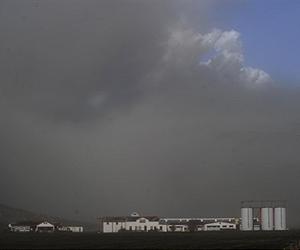
Ash from the volcano that shut down European airspace last week spread to the east of Iceland on Sunday, closing another airport in the Nordic island country to international traffic.
"We are now not using Egilsstadir airport, one of the international airports in Iceland, for air traffic for international flights," Civil Aviation Administration spokeswoman Hjordis Gudmundsdottir told AFP.
The country's main airport, Keflavik, meanwhile remained closed to traffic for a third day along with the smaller Reykjavik airport.
"It's pretty much the same as yesterday (Saturday), we have Keflavik, Reykjavik and now Egilsstadir, in the east of Iceland… there are no flights over there," she said, stressing the airports were closed for flights with instruments.
"A small plane could land and take-off at these airports, because it's possible to fly visual flights," she said.
International flights were re-routed through Akureyri Airport, a secondary facility in the north of the country.
"Akureyri Airport is the center now for flights to and from Iceland," Gudmundsdottir said.
Keflavik and Reykjavik airports were "probably" going to be closed until Wednesday, depending on the eruption, estimated Oli Arnason of Iceland's meteorological office Sunday.
Arnason told AFP that a change in high altitude winds had stretched the volcanic ash cloud to the east of Iceland, forcing Egilsstadir's closure.
He added that around next weekend, both the high and lower altitude winds were going to turn into northwesterly winds "which is more or less the same wind directions than when eruption started."
"But we have a lot less ash production in the volcano now, so we are not going to look at the same situation as we did then," when ash from the erupting volcano caused most European airspace to shut down.
"I could believe that we could get some ash into Europe, but probably not in the amount" that would cause a problem to European flight traffic, the meteorologist said.
Ash from the Eyjafjoell volcano brought air travel across most of Europe to a halt after it erupted on April 14, but spared Iceland's airports because it was blowing away from the island.
The volcano is still erupting, but spewing only a small amount of ash.
Share This Article With Planet Earth
