
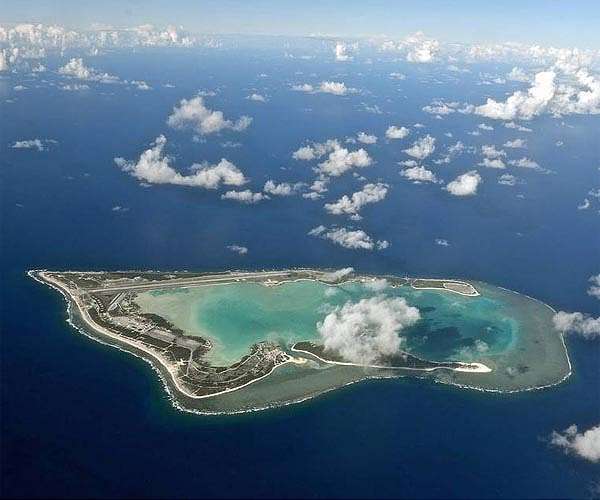
The Wake Island Airfield, regarded as among the most isolated installations in the U.S. military, is undergoing an $87 million upgrade, the Air Force said.
The infrastructure modernizations include improvements to the deteriorating runway, new lighting, and grounding and pavement markings to support mission readiness and global air mobility, the Air Force Civil Engineering Center at Joint Base San Antonio-Lackland, Texas, announced.
California-based contractor AECOM won the contract for the improvements in 2019, and is expected to complete the project in early 2021.
"The remote location of the Wake atoll required extensive logistics planning to ship construction equipment, material, parts and supplies which we successfully accomplished in November 2019," Capt. David Leonard, AFCEC project manager, said in a press release.
The three-island atoll in the Pacific Ocean, halfway between Hawaii and Japan, has been a U.S. possession since 1898, and has been under control of the U.S. Air Force since 1973.
It lies 1,501 miles east of Guam, 2,298 miles west of Honolulu and 1,991 miles southeast of Tokyo. With a runway 9,800 feet long, it serves as a crucial refueling depot for trans-Pacific military missions, as well as a training and missile testing area.
The airfield serves between 500 and 600 aircraft annually, according to the Air Force.
Sundown ceremony marks end of Marines' 'Tomcats' air squadron
Washington (UPI) Oct 19, 2019 –
A sundown ceremony for the storied Marine Attack Squadron 311 deactivated the unit as it and Marine Attack Squadron 214 transition to F-35 fighter planes in 2022, the U.S. Marine Corps said Monday.
Early next spring, the U.S. Marine Corps' VMA-311 squadron, known as the "Tomcats," and VMA-214, the "Black Sheep Squadron," will reactivate as Marine Fighter Attack Squadron 311, operating the F-35C Lightning II at Marine Corps Air Station Miramar, Calif., while VMFA-214 will fly the F-35B from Marine Corps Air Station Yuma, Ariz.
The ceremony, held last week at Yuma, marked the end of the use of AV-8B Harrier short-takeoff-and-landing aircraft by VMA-311, as well as the structure of the squadron, organized in 1942.
VMA-311 saw action in the Pacific theater of World War II and flew the first Marine jet combat mission in the Korean Conflict. The squadron also flew in combat missions in Iraq and Afghanistan.
"The reputable Tomcats have an exceptional level of esprit de corps representing 78 years of superior performance," Sgt. Maj. Colin Barry of VMA-311 said in a press release.
VMA-214 will also sundown, and the new unit will fly F-35C fighter planes from the Miramar air station, with the F-35B short-takeoff-and-landing variant flown from Yuma.
Three other active fleet squadrons and one training squadron, all based in North Carolina, will continue flying the AV-8B Harrier, Marine Corps officials said.
