
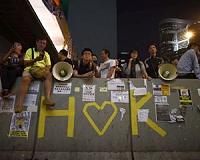
As Hong Kong is convulsed by fresh anti-government protests, many of those who have taken to the streets say they feel this is their last chance to protect the city's freedoms after years of slow strangulation by Beijing.
Four years ago huge pro-democracy "Umbrella Movement" protests brought parts of the city to a standstill for months, but that campaign eventually fizzled without the government making any major concessions.
The current protests are focused on a controversial proposal to introduce a law allowing extraditions to countries Hong Kong doesn't already have a treaty with — including China.
Organisers said over a million people took to the streets on Sunday — police put the figure at a more modest 240,000 — but pro-Beijing Chief Executive Carrie Lam has rejected all calls to delay or withdraw the bill.
"We have been listening and listening very attentively," she said after Sunday's protests, but insisted her administration had already made substantial concessions.
While the extradition law may be the rallying point for protesters, many say dissatisfaction is more deeply rooted.
Here are some of those voices:
Kit Ho, 35, a finance worker, had tears streaming down her face as she described why she felt compelled to join the protests.
"The government wasn't elected by the people and clearly they don't pass laws based on the universal values shared by Hong Kongers and the international community.
"There hasn't been any time for Hong Kong people to gasp for breath. We have worked so hard to build a civilised society."
Jason Ng, a lawyer and activist who wrote a book about the Umbrella Movement said the backlash against the extradition law had been caused by "outrage and worry" growing for years.
"Since the Umbrella Movement in 2014, Beijing has accelerated its political agenda for Hong Kong and tightened its grip on civil society.
"It's much more wary of dissent and less likely to give in to protests and other forms of popular demands, for fear that it might encourage and embolden civil society.
"The extradition bill controversy has backfired on Beijing by galvanising civil society once again, after years of apathy and protest fatigue in the aftermath of the Umbrella Movement.
"The more Beijing pushes, the harder Hong Kong people push back."
Claudia Mo, a veteran pro-democracy lawmaker, believes China's patience with Hong Kong's raucous democracy movement is wearing thin.
"Beijing is obviously fed up with Hong Kong after the Umbrella Movement, that Hong Kongers have simply refused to learn to be grateful and obedient to the mother country.
"But we won't accept defeat. The one million strong protest parade was a display of the power of the powerless."
Tom Chan, 28, a finance worker, took the day off work and donned a black mask and dark glasses to join the protesters because he felt profoundly pessimistic about the city's future.
"Of course I hope this can be resolved peacefully, without any clashes, but it depends on whether the government is willing to communicate with the people. If they continuously ignore the opinion of the whole society, then it could provoke resistance.
"I think this is even grimmer than the Umbrella Movement. The government is ignoring the will of the people even more after that occupation. I feel even more miserable now."
Hong Kong police use tear gas as protesters try to storm parliament
Hong Kong (AFP) June 12, 2019 –
Violent clashes broke out in Hong Kong on Wednesday as police tried to stop protesters storming the city's parliament, while tens of thousands of people blocked key arteries in a show of strength against government plans to allow extraditions to China.
Police used tear gas, rubber bullets and batons to disperse crowds of black-clad demonstrators — most of them young people and students — calling for authorities to scrap the Beijing-backed law.
Clashes broke out shortly after 3:00 pm (0700 GMT) — the deadline protesters had given for the government to abandon the controversial bill — and continued throughout the afternoon in the worst political violence the city has seen in years.
Rows of riot police battled protesters — many wearing face masks, helmets or goggles and using umbrellas as shields — who had gathered in the centre of the city ahead of a scheduled debate in the city's legislature.
That debate had to be rescheduled "to a later date" after huge crowds seized major roads outside the parliament.
The scenes echoed the pro-democracy "Umbrella Movement" of 2014 where protesters calling for greater democratic rights shut down swathes of the city for two months and battled police but won no concessions from Beijing.
In a repeat of four years ago people flooded major roads and junctions on Wednesday, dragging barricades onto highways and tying them together. Others plucked loose bricks from pavements.
After the deadline expired, protesters broke into the forecourt of the legislature in a bid to breach the building and demonstrators were seen throwing missiles including metal bars at riot police. An injured policeman was carried away unconscious.
Police beat back demonstrators first with batons and pepper spray, then firing rubber bullets and bean bag rounds — small fabric bags filled with lead pellets — and dozens of rounds of tear gas as they cleared one side of the surrounded parliament building.
Hong Kong's police chief Stephen Lo defended his officers, saying they had shown restraint until "mobsters" tried to storm parliament.
"These violent protesters kept charging at our line of defence, and used very dangerous weapons, including… throwing metal barricades at us and throwing bricks," he said.
– 'Million' march –
Many Hong Kongers are incensed that the government ignored a massive march on Sunday calling for the bill to be scrapped.
"It's the government who has forced people to escalate their actions, so I think it's inevitable for the fight this time to get heated," said 21-year-old protester Lau Ka-chun.
Organisers said more than a million people turned out on Sunday to oppose the proposed law, which would allow Hong Kong to send suspects to other jurisdictions around the world — including China.
But the record numbers failed to sway Hong Kong's pro-Beijing leader Carrie Lam, who has rejected calls to withdraw the bill.
Matthew Cheung, the city's chief secretary, on Wednesday called on demonstrators to withdraw.
"I also urge citizens who have gathered to show restraint as much as possible, disperse peacefully and do not defy the law," he said in a video message.
Opposition to the bill has united an unusually wide cross-section of the city from influential businesses and lawyers, to religious groups, student unions and workers.
Western nations have criticised the plans while Beijing has voiced support.
Opponents are fearful the law would entangle people in the mainland's opaque courts, leaving them vulnerable to a justice system seen as acting at the behest of the Chinese Communist Party.
– 'Hong Kong will bleed' –
Protesters vowed to stay on the streets until the bill is abandoned.
"Stalling is not our ultimate goal. We need them to consider scrapping it," said student Charles Lee, 23. "Clashes are unavoidable if they adopt this attitude towards their citizens."
Lawmakers had been due to debate the bill on Wednesday morning in the city's legislature, which is dominated by Beijing loyalists, with a final vote expected on June 20.
It was not announced when the next meeting on the bill would be held.
"The only responsible thing to do now is for Carrie Lam to withdraw the evil bill, or at least to shelve it in order to solve the crisis," said pro-democracy lawmaker Fernando Cheung.
Hong Kong's leaders say the proposed law is needed to plug loopholes and to stop the city being a sanctuary for fugitives, and that safeguards are in place to ensure that political critics of Beijing will not be targeted.
But many Hong Kongers have little faith in the government's assurances after years of heightened fears that a resurgent Beijing is trying to quash the city's unique freedoms and culture — despite a 50-year agreement between Hong Kong's former colonial ruler, Britain, and China that means the city is guaranteed freedoms unseen on the Chinese mainland.
Hong Kong's stock market sank nearly 1.8 percent on Wednesday in the city-wide turmoil.
